Introduction
There are many people who have been anxious in front of others when it comes to speaking English. The fear shared by millions of people throughout the world is the same. Fortunately, AI tools for English learning has revolutionized how people practice their speaking skills. No more having to pay a high price for a tutor or a set schedule for classes. Now you can practice English anytime, anywhere and receive immediate correction of pronunciation, fluency and grammar. In this article, you’ll discover the top AI tools and how to utilize them to become a more confident English speaker.
Table of Contents
Why Speaking English Feels So Hard
The most challenging English skill is speaking. Speaking is not like reading or writing, where you can think and mark your words down in sequence. When you speak you have to think quickly, mark your words correctly and be natural.
There are three major issues that most learners encounter. First, they are afraid of making mistakes in front of others. Second, they have no opportunity to practice with native(English speaking) speakers. Thirdly, there is not enough time for individual speaking practice in traditional classrooms.
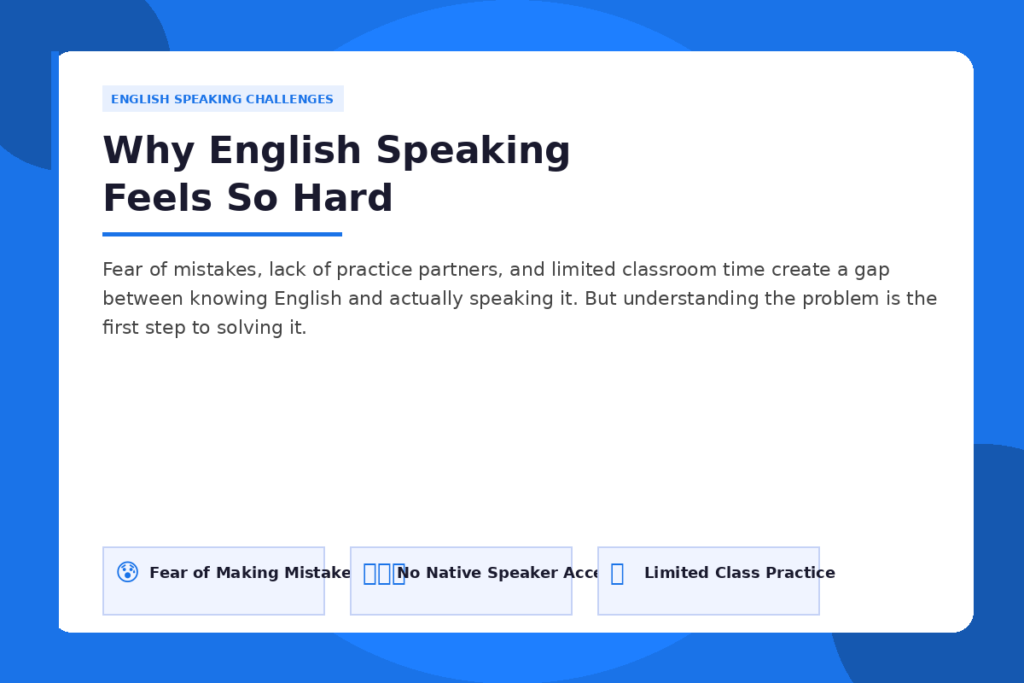
This leads to a significant gap between the knowledge of English and speaking it. There are people who can read and write English very well but who get paralyzed when they have to speak in English.
How AI Is Changing English Speaking Practice
The way people learn languages has been transformed in 2026 by AI tools. You can now discuss with an AI tutor anytime of the day, receive immediate feedback on your pronunciation and practice speaking without fear of being embarrassed in front of a real human being.
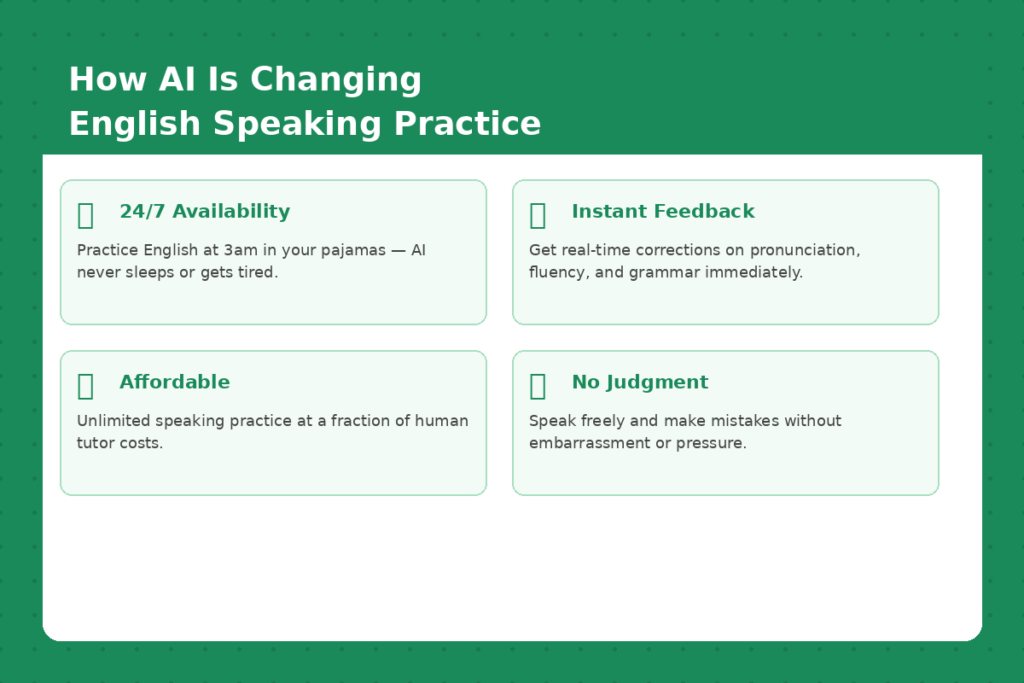
This is a big change. The traditional method of learning a language was to hire a human tutor for $30-60/hour, or to use an app such as Duolingo where most of the content was in the form of reading passages and multiple choice questions. Both opportunities were not cost free for learners to speak without much effort.
This is all transformed by AI. You receive instant corrections, customized lessons, and can practice as much as you like without any judgement.
Top AI Tools to Improve Your English Speaking Skills
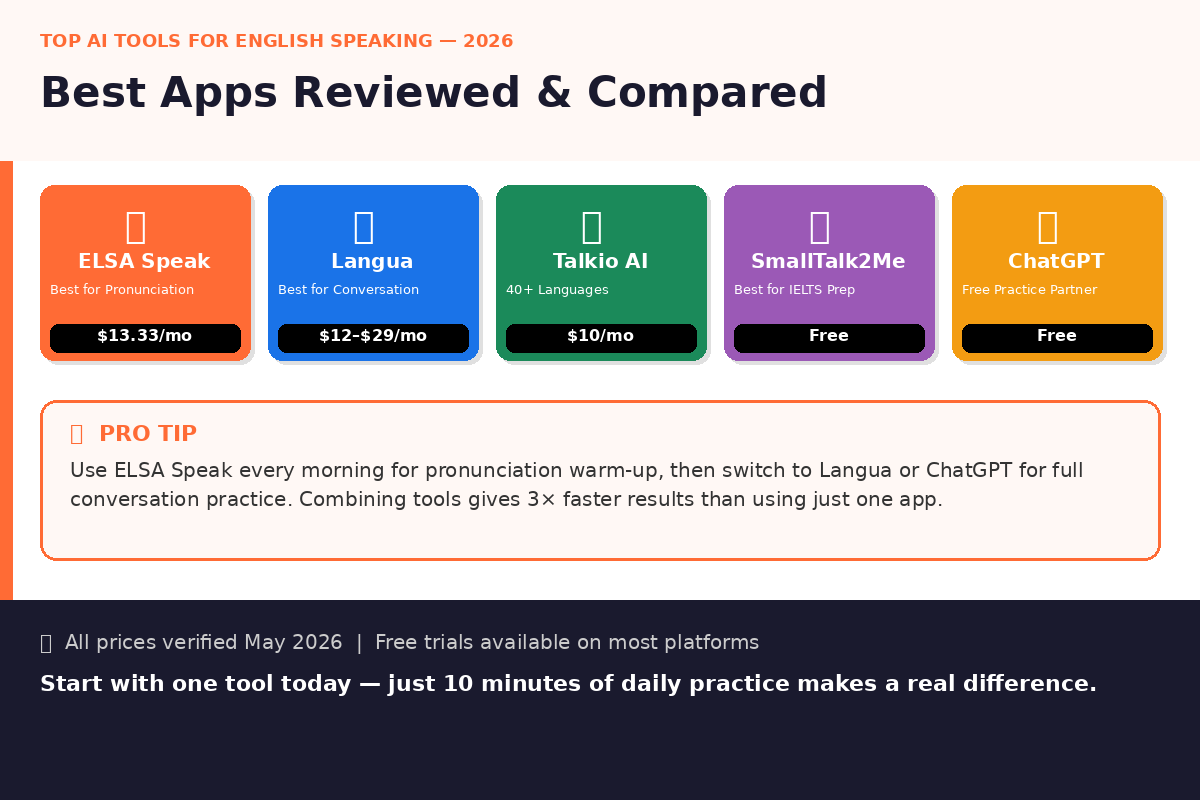
1. ELSA Speak — Best for Pronunciation
English Language Speech Assistant is the name of ELSA. One of the world’s most popular AI pronunciation tools at the moment.
ELSA is the first and best speech recognition app to assess and provide instant, comprehensive feedback on pronunciation and fluency. Assists you to find and master the right pronunciation.
ELSA’s self-learning AI technology monitors your performance and behavior data to tailor your daily lesson plans. ELSA says that 27 hours of study with the app is the same as a university ESL speaking class in the USA.
ELSA provides instant feedback on fluency, intonation, pronunciation, grammar and vocabulary. It also monitors your progress through detailed performance information and A1 (Beginner) to C1 (Advanced) level predictions.
Pricing: This annual subscription costs around USD 159.99 or USD 13.33 per month (annual). There’s also a free basic tier for basic pronunciation practice and limited lessons.
Ideal for: Students who wish to correct their accent and to speak in a natural manner.
2. Langua — Best Overall for Conversation
Langua is a fully-fledged AI system designed for students who are seeking to truly enhance their English language abilities. All in one place: conversation practice, vocabulary building, listening and reading.
What is so special about Langua is the authenticity of the conversations. Voices are copied from native English speakers, enabling the people to sound natural instead of robotic. Call Mode allows you to practice hands-free with a phone-style conversation – this is helpful to get comfortable talking naturally.
An AI memory system involves learning about you over time, so that conversations are more personalized between sessions. Grammar practice is also based on your individual errors — if you continue to make the same mistake over a certain structure, for example, Langua designates targeted grammar drills to help you overcome this obstacle.
The prices : $12–$29 per month based on plan. There is a free account, and a free trial of the Pro version.
Ideal for: Intermediate to advanced students seeking in-depth, authentic conversation skills.
3. Talkio AI — Best for Language Coverage
Starting at $10 per month, Talkio AI supports 400+ AI Tutors, real-time pronunciation feedback, team plans for schools and businesses, and 40+ languages and 134 dialects.
Talkio is only about talking. Following each conversation you receive a breakdown of what sounds to work on and how to work on them. It is very easy, simple and effective for daily practice.
ELSA Speak has the most comprehensive phonemic analysis if you’re focused on pronunciation accuracy and you’re studying English. For now, however, the voice of native speakers is the benchmark of natural sound for the best langua voices.
Ideal for: Students who wish to practice in a flexible, conversational manner at a low cost.
4. SmallTalk2Me — Best for Exam Preparation
SmallTalk2Me is ideal for those aiming to pass the IELTS exam or to take a job interview or simply to see how well they know English.
2.5 million students practice small talk in 125 countries with SmallTalk2Me, for IELTS preparation, job interview practice and everyday conversation.
The CEFR is a worldwide framework to rate speaking proficiency in English, which is graded from A1 (beginner) to C2 (proficient). A fluent and correct AI speaking test lasts approximately 15 minutes and consists of assessing fluency, pronunciation, words and grammar.
Starting the platform is 100% free. Take advantage for practice anytime without booking in sessions or waiting for a tutor to be available.
Ideal for: IELTS, TOEFL and job interview preparation in English.
5. ChatGPT / Claude — Best Free Conversation Partner
A special language application isn’t always required. ChatGPT and Claude are great free tools for practicing English that use AI.
Having a right-to-the-point prompt is the key to using ChatGPT or Gemini for conversational speech. In 2026, Voice Mode is one of the most effective free English speaking tools.
You can instruct these AI models to pretend to be an interviewer, customer service representative or a new friend. They will correct your grammar, suggest alternatives to the words you use and they will talk with you about anything you like!
No fee, no time and no pressure. It’s perfect for warm-ups every day before you download and use a specific app.
Ideal for: budget-conscious learners who need versatile, conversation practice without the money.
How to Use AI Tools Effectively — A Simple Daily Routine
The use of AI tools effectively is as simple as a routine!
The other half of the battle is having the right tool. The other half is using it regularly! This is a basic daily schedule for all levels.
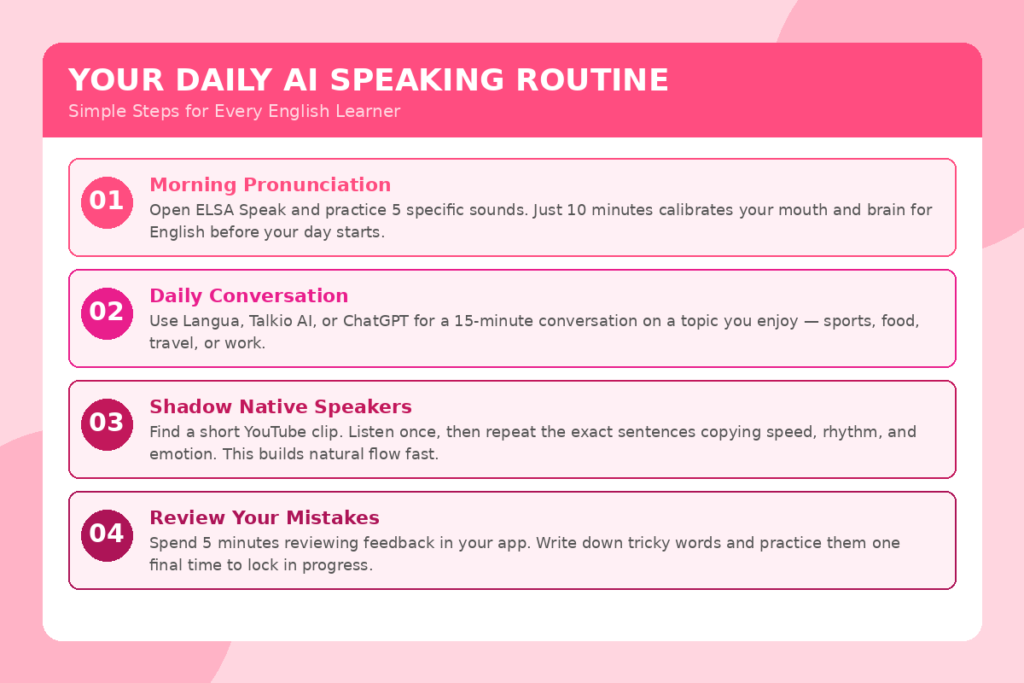
Step 1: Start Your Day with Pronunciation, with a duration of 10 minutes.
Morning: Open ELSA Speak and practice 5 sounds. This warms up mouth and helps train brain to focus on correct English sounds before a day begins.
Step 2 — Do a Real Conversation (15 minutes)
Have a brief conversation with Langua, Talkio, or ChatGPT. Choose a subject you’re interested in – sports, food, travel or your job. Discuss things you enjoy makes practice more like fun.
Step 3: Shadow a Native Speaker (10 Minutes), students will take their turn to learn from a native speaker.
Watch a short video or listen to a podcast. Now listen once, and repeat what you hear. Aim to imitate the speaker’s pace, rhythm and tone. This method is known as “shadowing” and is one of the quickest ways to be more natural.
Step 4: See Your Errors (5 minutes)
Return to the feedback part of your application. Examine the words/sounds that you missed. Write them down, and go over them again before you are done.
AI Speaking Practice by Level
| Level | Recommended Tools | Daily Goal |
| Beginner | ELSA Speak + SmallTalk2Me | 15–20 minutes |
| Intermediate | Langua + ChatGPT voice | 20–30 minutes |
| Advanced | Talkio AI + shadowing practice | 30–45 minutes |
Common Mistakes to Avoid
Many learners enter the learning process with a lot of energy but make some initial mistakes that hamper their learning.
Error 1: Using only one tool. The pros and cons available for each app. For pronunciation, use ELSA and for conversation, use Langua or ChatGPT. Tools can be used together to achieve better results.
Error 2: Only reading and writing. Use AI tools when you talk aloud. Use your voice, do not type your answers.
Mistake 3: Skipping review. “Unless you look at your errors, you will repeat them.” Review feedback for at least 5 minutes after session.
Error 4: Thinking that you will get overnight results. It was found that there were measurable improvements in pronunciation, vocabulary, fluency and comprehension after 8 weeks of consistent AI based speaking practice. Have patience and trust in the process.
Bonus Tips to Improve Faster
These are just a few little habits that can make a huge difference when incorporated into your AI practice routine.
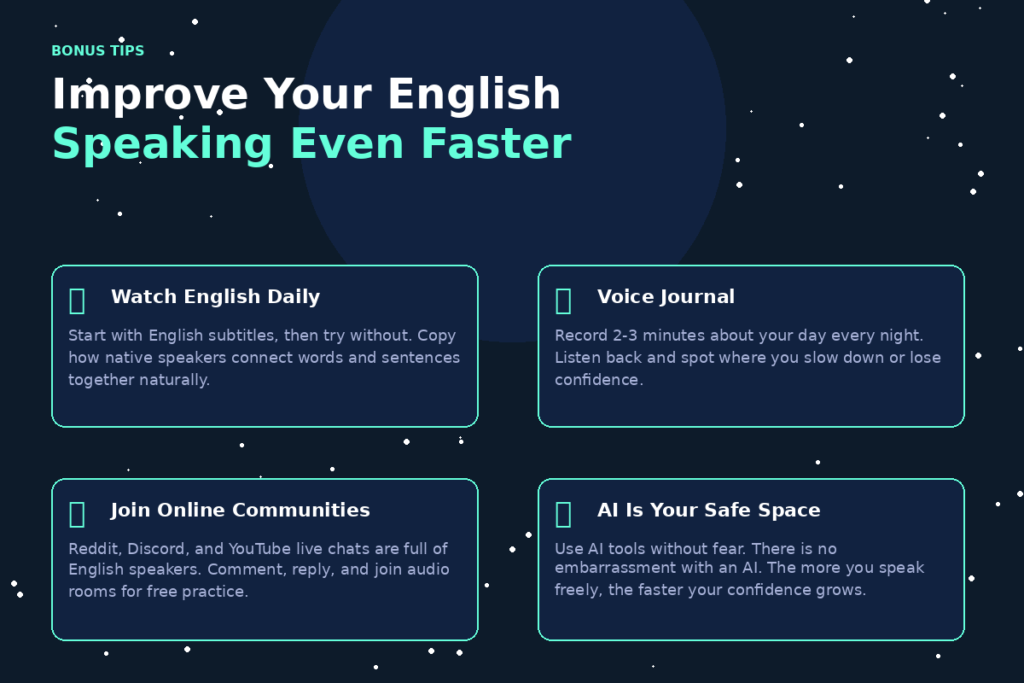
Increase viewing of English material daily. Use English subtitles at first and then attempt to do so without them. Watch and listen to the way words and sentences are linked together in native speech.
Use voice journaling. Write a short daily diary (2-3 minutes per night) of what happened to you. On the side, listen for areas of slowness or error.
Participate in an English speaking online community. There are a lot of English speakers on Reddit, Discord, and the comment sections of videos on YouTube. Consider making comments or even participate in a live audio chat.
Don’t fear making mistakes. AI tools offer a judgment-free and safe environment to practice English. This is a place where you will be encouraged to develop your confidence every step of the way. The more you speak, the better you get. — even if you get it wrong.
Should You Use AI Only or Combine It with Human Practice?
The ideal solution is a mix of AI and real-world practice. Practice speaking everyday with AI and listen to your pronunciation. Then meet with a human tutor once or twice a week to work on grammar, get cultural insights, and practice more complex conversations.
AI is great at providing immediate and uniform feedback. However, human tutors are more personal, bring warmth, a knowledge of different cultures, and the ability to understand your own learning preferences. When combined, they prove to be the most effective duo to becoming a fluent English speaker.
Conclusion
Being able to speak English fluently isn’t a gift, it’s a skill that can be taught with the right practice. From ELSA Speak to Langua, SmallTalk2Me, Talkio AI and ChatGPT, the best AI learning tools for English in 2026 have got you covered to learn at your own pace and time. Start small. Choose one tool and practice for 10-15 minutes each day and keep up the practice. You’ll see a real change in you in just a couple of weeks, and you’re sure to feel it. Now all that remains is to open an application and begin talking now.
FAQs
Q1. Is it possible to learn to speak English with the help of AI?
Yes. According to a study in 2025, pupils who practiced speaking with AI apps improved by 75% in speaking scores after 8 weeks. By practicing daily with AI tools, measurable improvements in fluency can be achieved.
Q2. What is the most popular free AI tool to practice English?
For conversation practice the best free options are ChatGPT and Claude (with Voice Mode). SmallTalk2Me is also an excellent free offering, featuring CEFR-level tests and daily speaking exercises.
Q3. What is the time frame for improvement of English speaking using AI?
The majority of learners experience improvement in 4-8 weeks of daily practice of 15-20 minutes. Success will depend on your starting point, and your practice frequency.
Q4. Does ELSA Speak have a better pronunciation than Duolingo?
Duolingo teaches how to construct the language, ELSA refines how the bricks look and sound when spoken. In terms of pronunciation, ELSA Speak is much more specific and effective than Duolingo.
Q5. Can I use ChatGPT to practice English conversation?
Yes. You can ask ChatGPT to role-play real-life scenarios like job interviews, travel situations, or casual conversations. It will correct your grammar and suggest better phrasing — making it one of the most flexible free tools available.