Introduction
With 2026 being one of the largest releases of Artificial Intelligence, choosing between two of them is no easy task, and that’s why many are looking for Kimi K3 vs GPT-5.6 Sol right now. After OpenAI’s GPT-5.6 Sol went into general availability on July 16, 2026, Moonshot AI released its own Kimi K3 model a week later. Moonshot AI released its Kimi K3 model a week after OpenAI’s GPT-5.6 Sol went into general availability on July 16, 2026. There is one model that is open weight and affordable. The other is closed, polished and designed for OpenAI’s ecosystem. The author will explain the cost, the comparisons and the specific applications for your project in an easy to understand manner so you can select the right one without getting bogged down in technical jargon.
Table of Contents
What Is Kimi K3?
Moonshot AI’s 2.8T Parameter Open-Weight Model
Kimi K3 is Moonshot AI’s latest flagship, which was released on July 16th, 2026. The 2.8 Trillion total parameters is the largest open weight model ever shipped. By July 27, 2026, full model weights will be released, allowing developers to self-host it on their own hardware.
Even though K3 is a giant, it is also constructed to be efficient. It is a ‘mixed’ design, meaning it does not use all its brain for all its activities. That way, it keeps expenses low and still provides a frontier-level coding, reasoning, and visual performance.
Key Architecture Features
There are 896 specialized expert networks in the K3 architecture, with only 16 networks being activated at any given time for the token. This selective activation makes the model fast and economical even though it is so big.
It also incorporates a special method known as Delta Attention, which enhances its ability to remember information in long conversations. This is combined with attention residuals to assist K3 to process its entire context window of 1 million tokens without dropping information from the past, achieving a score of 90.4 on a challenging test set with 1M tokens.
K3 is also packaged with an always-on “thinking mode,” so that it goes through problems step-by-step and give the final answer, instead of giving the answer immediately. That’s one reason for its relative effectiveness on multi-step coding and reasoning problems, even though it costs less than some of the other tests. This is one of the main reasons why K3 is so attractive to developers compared to the open weight models that have been released to date.
What Is GPT-5.6 Sol?
OpenAI’s Flagship in the GPT-5.6 Family
It was released, in a general way, on July 9, 2026. For all the validation of the model, it is the model that Moonshot used as the target when announcing Kimi K3.
Sol has an “Ultra mode” setting, which takes multi-agent reasoning beyond the normal mode. The mode proves to be some of Sol’s best, as he achieves a score of 91.9% on Terminal-Bench 2.1.
The Ultra mode is actually a coordination of several reasoning passes that occur in the background, allowing Sol to “double check” its reasoning as it generates a final answer. This method requires much more compute than a “standard” response which is why some of Sol’s benchmark numbers take longer than a “standard” query. It’s a conscious decision: slower and more expensive, but when it’s important to get it right, not speedy.
How Sol Differs From Terra and Luna
GPT-5.6 is not a specific model but a range of models. It is a family of three, Sol, Terra and Luna. All of them can be used for various purposes, with varying budgets.
Sol is the flagship, which is $5 per M input and $30 per M out. The performance of Terra is comparable to that of the older GPT-5.5, and it costs about half as much, at $2.50 and $15. Luna is the fastest and least expensive of the three, designed for basic/high volume tasks. They all have a context window of more than 1 million tokens.
Kimi K3 vs GPT-5.6 Sol Price Comparison
Input and Output Token Costs
One obvious distinction between the two models is price. Kimi K3 demands $3 per million input tokens, and $15 per million output tokens. GPT-5.6 Sol charges $5 per Million input tokens and $30 per Million output tokens.
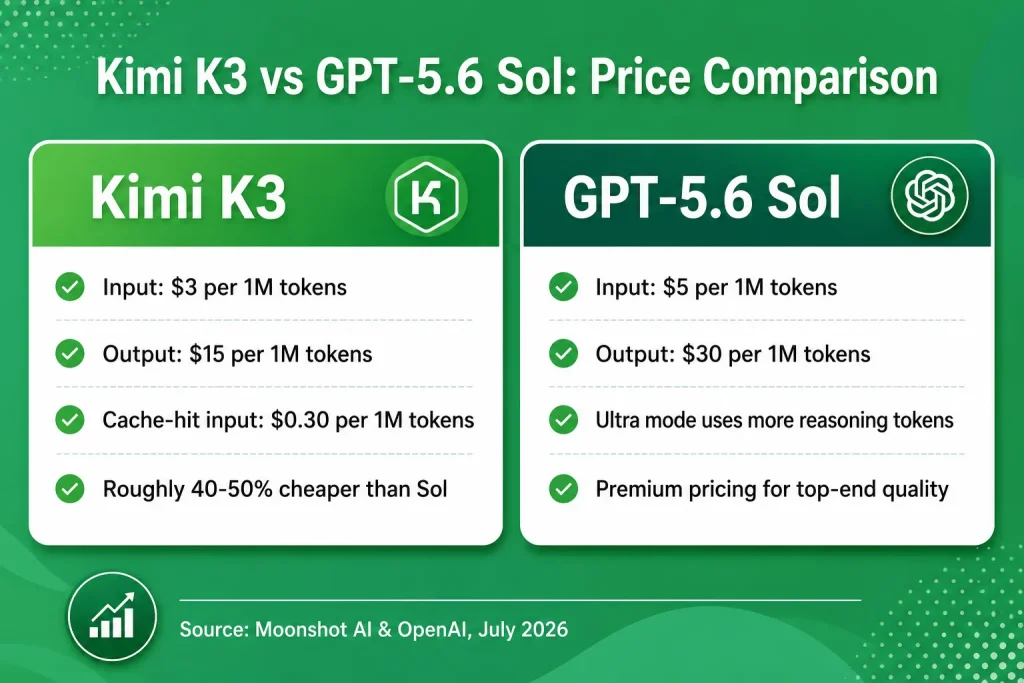
Depending on your input and output, the price of Sol is approximately 40% – 50% higher than the price of K3. Over the course of a month that gap can add up for big teams of requests.
Cache-Hit Pricing and Real-World Task Cost
Both models provide reduced pricing if using the same content from cache. Its standard price is $3 per million tokens, but Kimi K3 will sell for just $0.30 when it is found in a cache. This is most important for applications that use a system prompt or a long document in numerous requests.
Also, real-world cost is related to the number of tokens a model employs to solve a problem. In Ultra mode, Sol will be able to use more reasoning tokens to achieve the highest benchmark scores, helping it to close the price gap on complex tasks, despite the list price being higher.
Performance Benchmarks
Intelligence Index and General Reasoning
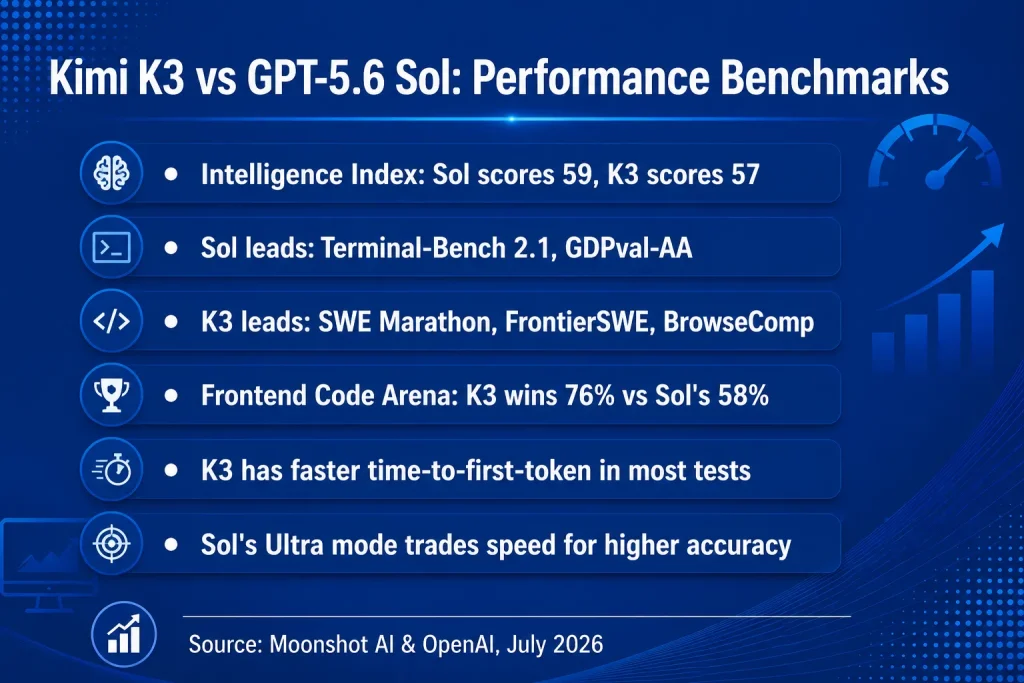
GPT-5.6 Sol and Kimi K3 have similar scores on the Artificial Analysis Intelligence Index, a popular index that averages nine separate evaluations. This implies that, in terms of raw, general intelligence, Sol is the stronger model, although the difference is not significant.
Moonshot has been open about this and pointed out to us that K3 is still behind the very best proprietary models. It’s not a victory, but a solid second place and K3 is fourth overall in the frontier rankings.
Coding and Agentic Benchmarks
The fun really begins when you start coding. Sol is ahead of a number of the shared benchmarks, such as Terminal-Bench 2.1, particularly when playing in Ultra mode. It also has good performance on a benchmark related to authentic professional tasks GDPval-AA.
Yet on several measures of its own, such as Kimi k3’s performance on an agentic and coding task, it outperforms. It also has a 76% win rate over Sol in the Frontend Code Arena (run by the community) and comes out ahead on SWE Marathon, FrontierSWE, and BrowseComp. K3 is very cost competitive and competitive for many common coding applications.
Speed and Latency
Latency values are very different depending on the source and on the mode tested. In some independent tests Kimi K3 proved to be very fast to get to the first token, with a response time of only a few seconds. If you’re looking for the best user experience, GPT-5.6 Sol Ultra mode, which delivers the highest benchmark scores, is significantly slower due to its multi-agent reasoning process.
Context Window and Multimodal Capabilities
They both can serve context windows that are larger than 1 million tokens, which can be sufficient to serve very large documents, codebases, or conversation histories in a single request. Kimi K3 has a context window of 1,048,576 tokens, and it maintains its accuracy even at these large scales.
K3 also provides multimodal capabilities, enabling it to handle images in addition to text, for tasks such as visual iteration and interface work in the front end. GPT-5.6 Sol also offers the capability to accept multimodal inputs and can be trained for controlled, adjustable reasoning steps, which allows greater control over the amount of “thinking” done by the model before generating an answer.
A large context window is most important when you’re working on large code bases, long legal documents, or long research papers that require reading in its entirety without breaking them into parts. Both models can easily handle this type of work, but it is usually a matter of price and hosting rather than ability. If you have a workload that is routinely approaching the 1-million-token limit, you should test both models first-hand, as the accuracy at the end of a large context window can differ between providers despite the advertised limit.
Best Use Cases for Kimi K3
Self-Hosting and Open-Weight Projects
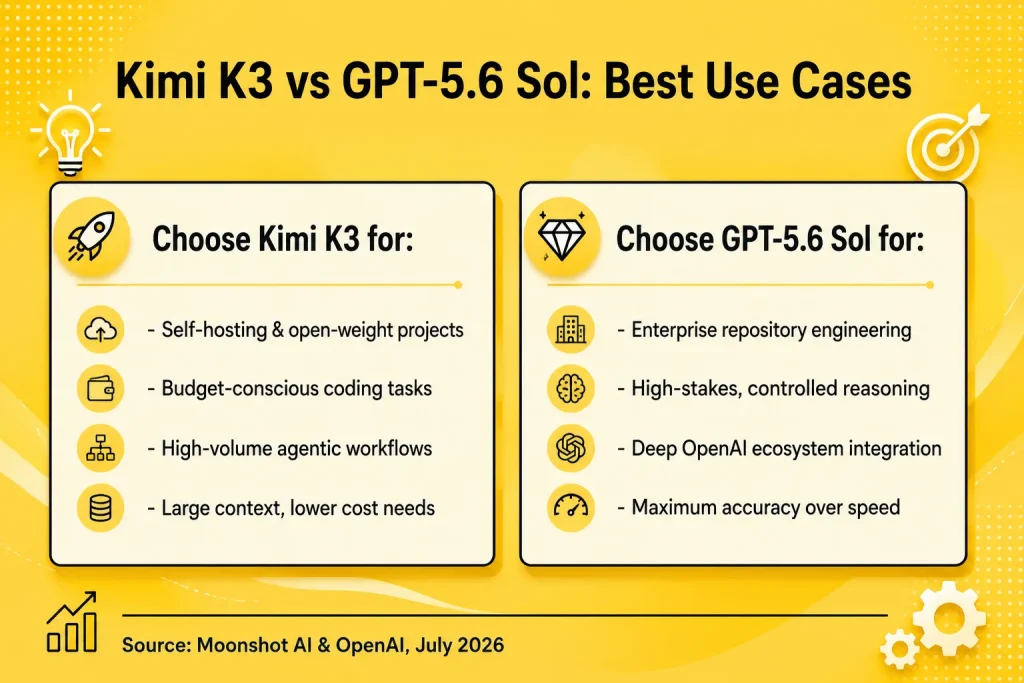
Where a full control of the model is required, K3 has a distinct advantage. It is being made available under a modified MIT license, meaning you can self-host once it’s available. This is important for companies that have a high degree of confidentiality requirements or prefer not to rely on a single provider for their API services.
Budget-Conscious Coding and Agentic Tasks
K3 is a great match for teams that want a leading edge codebase but don’t want to pay a frontier level price. It outperforms several agentic and front-end benchmarks in both parameters, and is more cost effective for large volume use cases such as automated code review, agents used via the terminal, or long-running autonomous tasks.
K3’s value for money is ideal for start-ups, indie developers and those with more limited budgets for research.
Best Use Cases for GPT-5.6 Sol
Enterprise and High-Stakes Repository Engineering
For large, complex codebases where accuracy matters more than cost, Sol is the safer pick. It holds a lead on difficult repository engineering benchmarks and benefits from OpenAI’s mature developer ecosystem, including deep integration with tools like Codex.
Enterprises that need consistent, well-supported infrastructure and are less sensitive to per-token pricing will likely find Sol’s ecosystem worth the premium.
Tasks Requiring Ultra Mode
Sol’s adjustable reasoning depth and Ultra mode make it well suited to tasks where you need the model to slow down and reason carefully. This includes multi-step professional workflows, complex debugging, and tasks measured by benchmarks like GDPval-AA.
If your use case can tolerate longer response times in exchange for higher accuracy on the hardest problems, Sol’s Ultra mode is a genuine advantage.
Which One Should You Choose?
No one is a winner in this. If you’re looking for the most impressive of all the raw intelligence, deep reasoning control, and access to the OpenAI ecosystem, then you should opt for GPT-5.6 Sol, which will require you to shell out a little more to get your hands on. If you are looking for open weights, self-hosting flexibility, a huge context window, and good coding performance but at a much lower price, you should choose Kimi K3.
If you have time, the best way is to try both models on your own real data. While benchmark scores can be helpful signals, not all winning models will win for your prompts, tools and budget.
Also, consider where your project is going and not where it is at the present time. For a small team developing a fledgling product, K3’s lower cost and self-hosting could be more desirable as it tests and refines new prototypes and product concepts. A more substantial company that is shipping a production system which requires high accuracy requirements may choose to go with Sol’s ecosystem and consistency, regardless of the cost. Both are not permanent and are being used by many developers with different parts of the same application.
Conclusion
The choice between Kimi K3 and GPT-5.6 Sol depends on your preferences. Meanwhile, Sol is a head start on general intelligence and boasts a mature, closed ecosystem with OpenAI support, while K3 provides open weights, a huge context window, and coding prowess at about half the cost. There is no clear winner or no clear loser, which makes this matchup one of the closest open/closed AI races ever. However, if budget and flexibility are the most important factors, K3 is the better choice. For the most critical, high-stakes jobs, you’ll be safer with Sol..
FAQs
1. Is Kimi K3 cheaper than GPT-5.6 Sol?
Yes. Kimi K3 costs $3 per million input tokens and $15 per million output tokens, compared to Sol’s $5 and $30, making K3 roughly 40-50% cheaper.
2. Which model is better for coding?
Sol leads on some benchmarks like Terminal-Bench, but K3 wins SWE Marathon, FrontierSWE, and Frontend Code Arena, making it highly competitive for coding at a lower cost.
3. Can Kimi K3 be self-hosted?
Yes. Moonshot is releasing K3’s full weights under a modified MIT license by July 27, 2026, allowing self-hosting on sufficient hardware.
4. Does GPT-5.6 Sol outperform Kimi K3 on benchmarks?
Sol leads on overall intelligence and several coding benchmarks, but K3 outperforms it on others, especially agentic and frontend tasks.
5. What’s the difference between GPT-5.6 Sol, Terra, and Luna?
They are three tiers of the same GPT-5.6 family. Sol is the flagship, Terra is a mid-cost option matching GPT-5.5, and Luna is the fast, budget tier.