Introduction
Google has just announced Gemini 3.6 Flash, an AI model that will be fast, cheap, and truly helpful for everyday tasks, such as coding and research. It’s here at a time when everyone was eagerly waiting for Gemini 3.5 Pro, but Google is calling it a “workhorse” version. It explains what it is, how it does it, how it compares in benchmarks, and if it’s worth beating older Flash models.
Table of Contents
What Is Gemini 3.6 Flash?
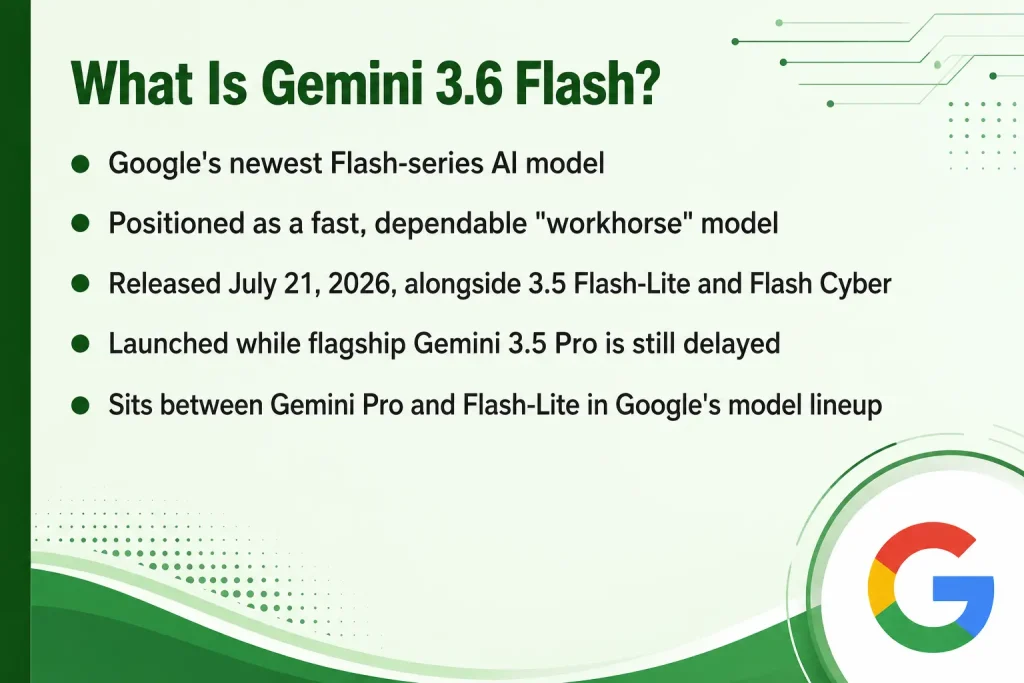
Google’s newest addition to the Flash family is called Gemini 3.6 Flash, and it’s designed for speed and efficiency—not size. It’s optimized for handling multi-step tasks such as coding, research, and document processing, without wasting tokens or getting stuck in a time-consuming loop.
Google’s Workhorse Positioning
According to Google, this is the trustworthy and regular service. It’s not designed to be the smartest model Google has ever produced. Rather, it is designed to do “real” work in a quick and inexpensive manner, and that is very important to developers who might be running it thousands of times each day.
Release Date and Rollout
Gemini 3.6 Flash launched on July 21, 2026. It came with two other new models: Gemini 3.5 Flash-Lite and Gemini 3.5 Flash Cyber. The timing is interesting as the earlist mention of Google’s flagship Gemini 3.5 Pro model was at its I/O event in May.
Gemini Lineup Fit
Imagine that the lineup is a ladder. In the most difficult logic questions, Gemini Pro is the superior choice. Flash is the middle ground choice, a balanced option. At the bottom is Flash-Lite, for the lowest-priced and fastest work. With 3.5 Flash, the goal is to close the gap between the quality found in Pro-level software, and still remain fast and affordable.
Key Features of Gemini 3.6 Flash
Google made this update rather than a complete overhaul, to specific improvements. This is how things have changed.
Improved Token Efficiency
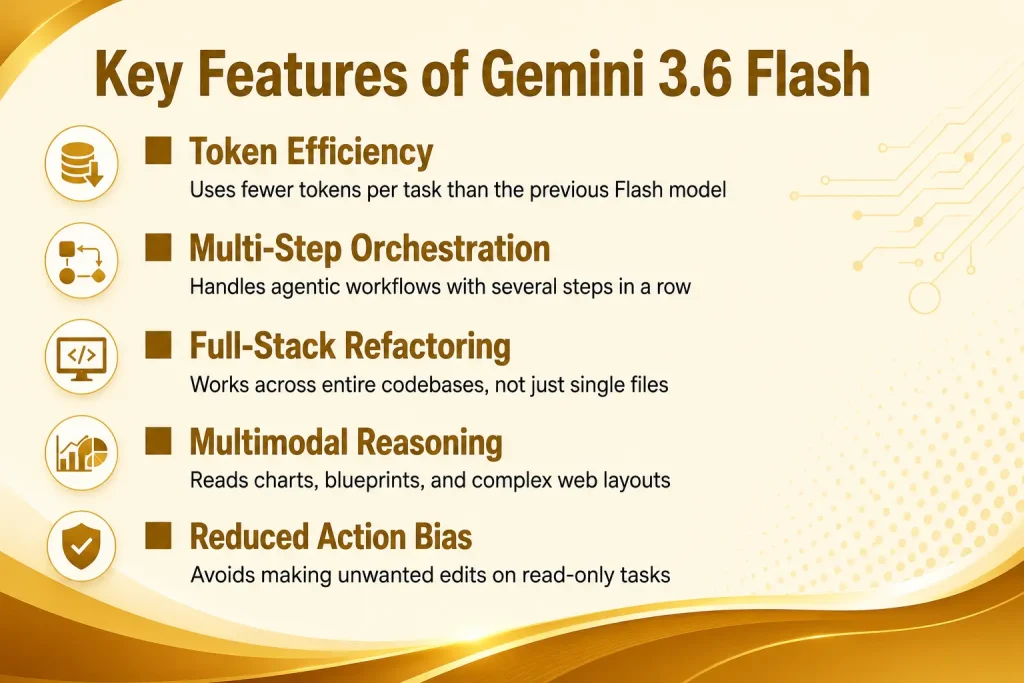
This is the main special highlight. The amount of tokens used by Gemini 3.6 Flash is significantly less for the same tasks than its predecessor. The fewer the tokens, the quicker the responses and the lower the costs – particularly if the workflow cycle is executed numerous times each day. In certain coding tests, the savings in tokens are up to 65%.
Multi-Step Agent Workflows
The model is designed for a series of actions, such as planning action, performing action, verifying action outcome, and modifying action if it is wrong. This is important for AI agents when doing real work and not having a human reviewing each and every step.
Full-Stack Code Refactoring
Not only does Gemini 3.6 Flash work in individual files, but it can work on an entire codebase. It’s designed to be more accurate when working on larger coding projects, such as updating code in multiple files or switching to a new framework.
Multimodal Reasoning
The model can understand and interpret images, charts, blueprints and make inferences about what it sees. Google in particular has enhanced their capability to read charts, to convert visual designs to code, and to comprehend intricate web page designs that are made of numerous elements.
Reduced “Action Bias”
A common issue with AI coding assistants is that they change things even when you merely asked a question. Gemini 3.6 Flash is designed to understand tasks that don’t require interaction, such as debugging a bug, and respond without doing unwanted modifications to the code.
Gemini 3.6 Flash Benchmarks
Numbers matter here, so let’s look at how the model actually performs.
Coding Performance
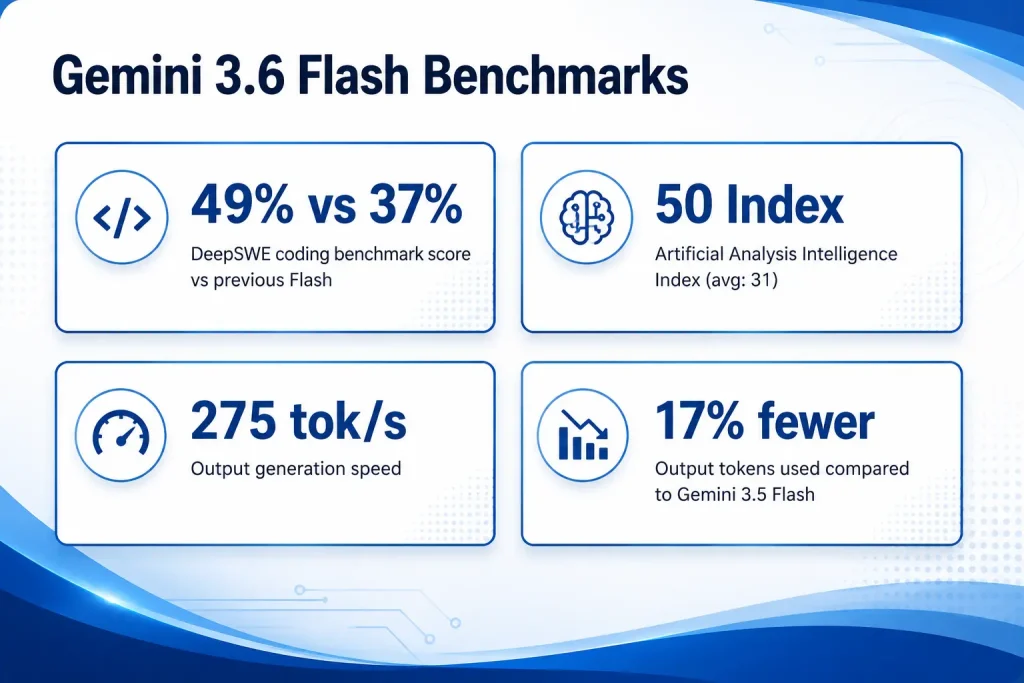
Coding benchmark DeepSWE: Gemini 3.6 Flash achieves 49% whereas the previous Flash achieves 37%. A significant step towards greater reliability in real-world coding. It also had a strong increase on MLE Bench, a benchmark that focuses on machine learning research tasks.
Intelligence Index Score
Compared to the overall model capability Artificial Analysis Intelligence Index, Gemini 3.6 Flash achieved a score of 50. That’s higher than the average of 31, which is earned by models of its price.
Speed and Latency
The model’s execution speed is around 275 tokens per second, significantly higher than the median for reasoning models with similar token prices. Its time to the first token is approximately 12.5 seconds, which is not the quickest time for models of this class. In reality it takes a little longer for the model to “listen” and start responding, but as soon as it begins it comes up with its answer.
How It Compares to Gemini 3.5 Flash
On average, Gemini 3.6 Flash uses approximately 17% fewer output tokens compared to 3.5 Flash. It also does multi-step workflows in less turns, which means that there are fewer up and down exchanges required to complete a process. This update enhances coding accuracy, output quality and cost efficiency.
Gemini 3.6 Flash Pricing
Cost can often be the deciding factor for developers in their choice of models, so here’s the cost breakdown.
Input and Output Token Costs
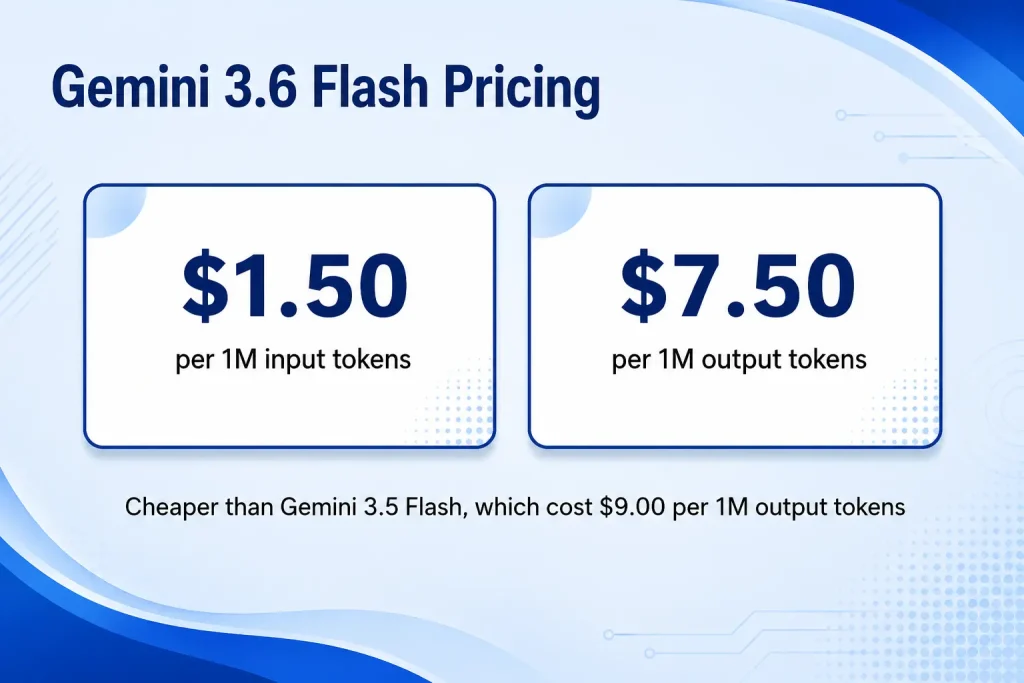
The rates for using Gemini 3.6 Flash are $1.50 per million input tokens and $7.50 per million output tokens. Both will be lower, around $1.75 per input and $9.00 per output, for similar models.
3.5 Flash Cost vs. Competitors
This is a true price reduction along with an upgraded capability, as compared to the $9 per million output tokens of Gemini 3.5 Flash. The combination of low cost and high performance is rare and appealing in high volume applications such as customer support bots or coding assistants that are used in the background continuously.
Is Gemini 3.6 Flash a True Pro Alternative?
Yes, for most routine activities. In this model, Google has claimed that the quality of coding and reasoning is similar to that of Gemini Pro, but Flash remains with its lower prices and quicker speeds. For general coding, document review or research-related work, Gemini 3.6 Flash may be able to replace Pro without a significant loss in quality if it’s not the highest cognitive level of reasoning. The Pro tier models might still perform better when it comes to very complex and consequential reasoning tasks.
Gemini 3.6 Flash Limitations
But no model is perfect and there are a few quirks of which you should be aware before you make the switch.
Fixed Temperature, Top-K & Top-P
If you’re used to fine-tuning creativity settings like temperature or top-K sampling, this model won’t let you. Any custom values you set for these parameters are simply ignored, which is a change from earlier Gemini models.
Multimodal-to-Text Output
While the model can read images, video, and speech as input, it only outputs text. So you can show it a chart or a screenshot and ask questions about it, but it can’t generate images or video back to you.
How to Access Gemini 3.6 Flash
Getting started with the model is straightforward through a couple of main channels.
Google AI API
Developers can access Gemini 3.6 Flash directly through the Gemini API starting from its release date. This is the most direct route if you’re building your own application or tool.
Third-Party Platforms
The model is also available through routing platforms like OpenRouter, which let you access it alongside other AI models and compare pricing across different hosting providers. This can be a convenient option if you’re already using multiple AI models in one project.
Conclusion
Gemini 3.6 Flash lands as a smart middle-ground option: cheaper and faster than Pro-tier models, but noticeably better at coding and multi-step tasks than its own predecessor. With lower token usage, stronger benchmark scores, and reduced pricing all at once, it’s a solid upgrade pick for developers already using Flash models, and a reasonable Pro alternative for everyday coding and reasoning work.
FAQs
1. What is Gemini 3.6 Flash used for?
It’s built for coding, multi-step AI agent tasks, document analysis, and general reasoning, all while staying fast and low-cost.
2. How much does Gemini 3.6 Flash cost?
It costs $1.50 per million input tokens and $7.50 per million output tokens through Google’s API.
3. Is Gemini 3.6 Flash better than Gemini 3.5 Flash?
Yes, it uses about 17% fewer output tokens, scores higher on coding benchmarks, and costs less per output token.
4. Can Gemini 3.6 Flash generate images or only text?
It only outputs text, even though it can accept images, video, and speech as input.
5. Is Gemini 3.6 Flash available to developers now?
Yes, it launched on July 21, 2026, and is available through the Gemini API and platforms like OpenRouter.