Introduction
AI has now got a new challenger. Kimi K3 vs Claude Fable 5 is one of the biggest topics in tech these days as the massive new model from Moonshot AI gets a run-off-the-board showing from Anthropic’s flagship model. Kimi K3 launched on July 16, 2026, boasting 2.8 trillion parameters and a huge context window. Meanwhile, Claude Fable 5 is still one of the most powerful AI systems on the market today. This article explains the differences between these two models in terms of coding, benchmarks, and size of context window and which one is best for you.
Table of Contents
What Is Kimi K3?
Moonshot AI and the 2.8T-Parameter Model
Kimi K3 is the latest flagship product of Kimi, a Beijing-based startup that’s also known for its Kimi chatbot and the previous Kimi K2 model family. It was announced to be launched on July 16, 2026, initially on Kimi Code and Kimi app.
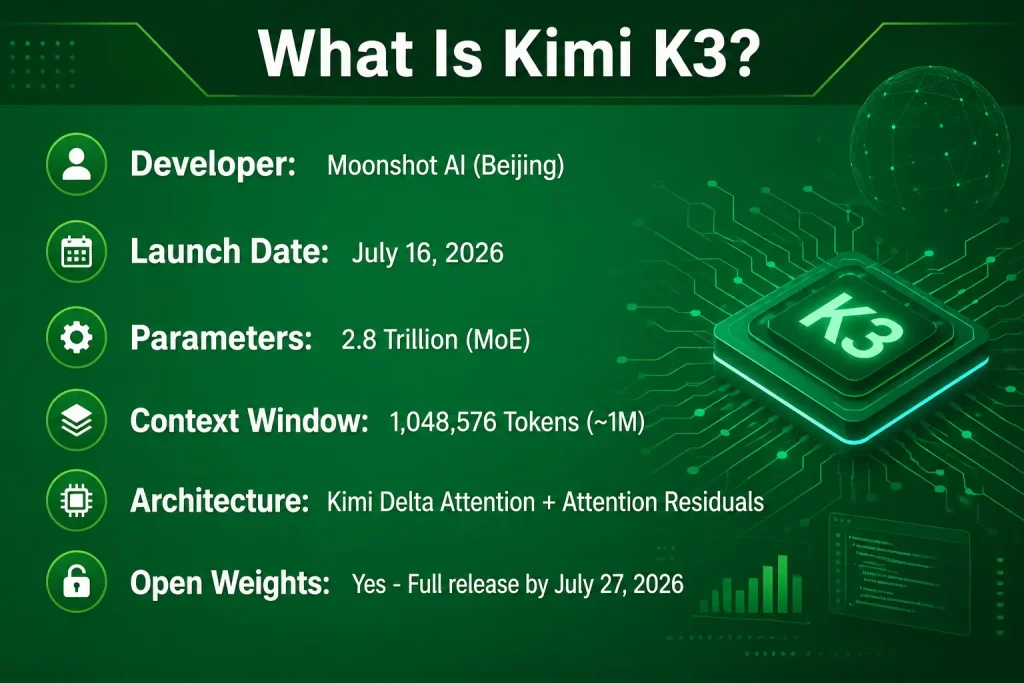
Moonshot is the world’s first open-source model in the 3-trillion-parameter class, with a total of 2.8 trillion parameters. At launch, it will be offered in two flavors: K3 Max (for chat and agent tasks) and K3 Swarm Max (for large-scale parallel processing).
Key Architecture — Kimi Delta Attention & Attention Residuals
The two custom architectural pieces form the basis of Kimi K3. The first is Kimi Delta Attention (KDA), a combination of linear attention that helps to make processing more efficient. The second is that of Attention Residuals, which Moonshot calls a “drop-in” replacement for the standard residual connections.
These work together to make the model ‘fast enough’ to deal with very long inputs without slowing down too much. The model also has native visual understanding, which means that it can process images without having to add a separate vision system to the machine.
Open-Weight Availability and Pricing
Kimi K3 is an open weight machine, which means that the eventual plan is to make it possible for developers to download and run it on their own machines. Expect full model weights to be available by July 27, 2026.
The API pricing is $0.30 per million tokens for input with a cache hit and $3 per million for input with a cache miss, and $15 per million for output. There’s been enough demand to make Moonshot temporarily stop accepting new subscribers after just a few days.
What Is Claude Fable 5?
Anthropic’s Mythos-Tier Model
Claude Fable 5 is in Anthropic’s newer Tier – Mythos, which comes after the Opus line. It’s based on the same model as Claude Mythos 5, but Fable 5 has additional safety filters on biology, cybersecurity and AI research questions.
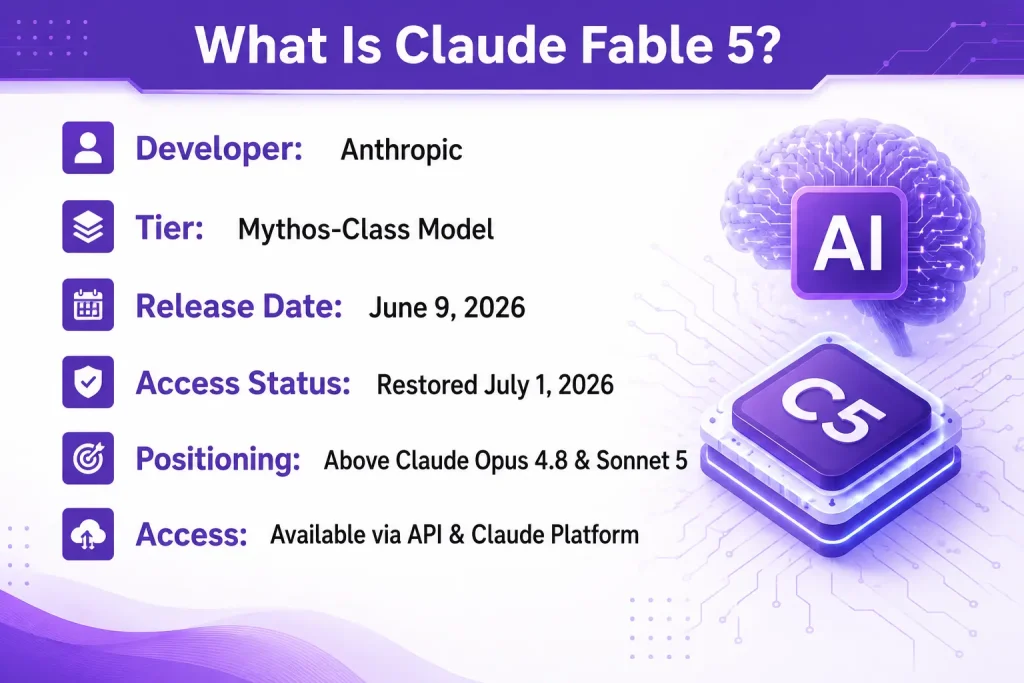
Fable 5 will be released on June 9, 2026. Periodic temporary shutdown between June 12 and June 30 in compliance with the U.S. Department of Commerce’s export-control restrictions were subsequently reopened on July 1, 2026, when the restrictions were lifted.
Positioning vs Claude Opus 4.8 and Sonnet 5
Claude Opus 4.8 and Claude Sonnet 5 are currently the two most capable models available on Anthropic. Right now, Claude Opus 4.8 and Claude Sonnet 5 are the two most powerful models that Anthropic has in its lineup. Fable 5 has consistently been ranked high in the comparing of new releases from the AI field in various reports, along with OpenAI’s GPT-5.6.
This is relevant to Kimi K3 vs Fable 5 comparison, as Moonshot has admitted that Kimi K3 isn’t as high performing as Fable 5 and much worse than some of its other competitors.
Access and Availability
In addition to the current models, such as Opus 4.8, Sonnet 5, and Haiku 4.5, Claude Fable 5 is also available via Anthropic’s API and Claude Platform. It is designed for a company or developer that requires the highest performance of the frontier for complex tasks.
Coding Performance Compared
Repository Navigation and Debugging
Kimi K3 has been customized for code development, such as browsing through large code bases, debugging and adjusting based on test results and logs. Moonshot made it to be easy to use inside an agentic coding tool that requires a step-by-step exploration of a repository.
Claude Fable 5 is also well-suited for these tasks, where Anthropic’s extensive experience in coding-focused model development in the Claude Code product line comes into play.
Tool Use and Iterative Workflows
These models can be used in agent harnesses, which are the other software that provide a model access to tools, terminal, and files. Some popular harnesses include Kimi Code and Claude Code; each one has various prompts, permissions, and retry behavior.
This is important because the coding benchmark scores may vary based on harness. It is possible for a model to behave differently in its “home” harness than in a third-party harness.
Real-World Coding Benchmark Results
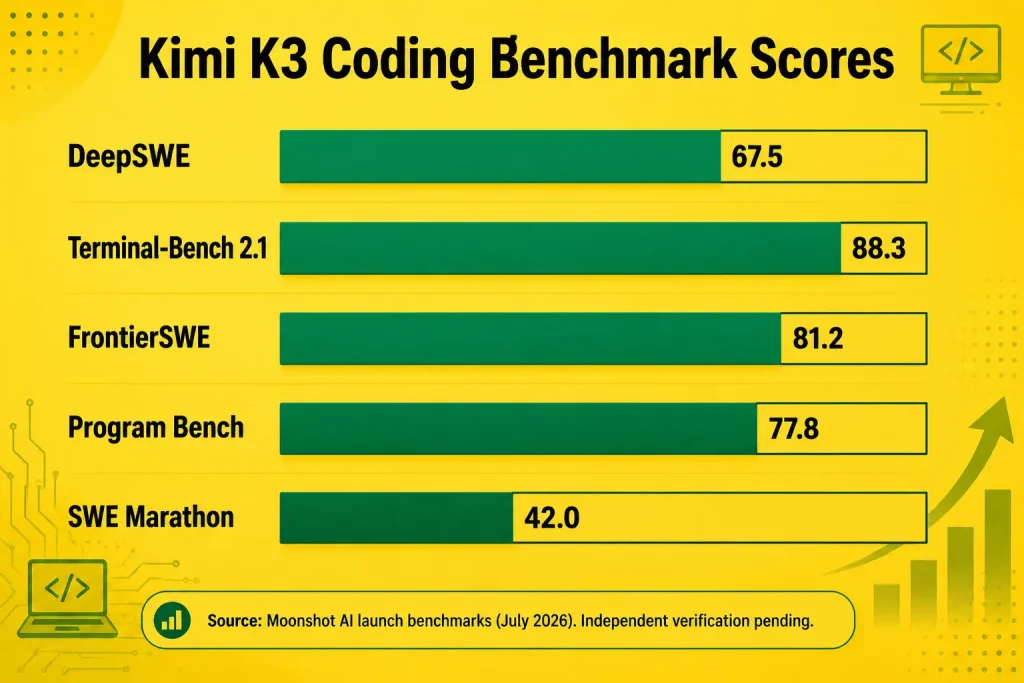
Moonshot has reported Kimi K3 scores of 67.5 on DeepSWE, 88.3 on Terminal-Bench 2.1, 81.2 on FrontierSWE and 77.8 on Program Bench. In SWE Marathon, a test of long, sustained engineering tasks, K3 outperformed Claude Opus 4.8 with a score of 42.0, and GPT-5.6 Sol, with a score of 39.0.
But there is yet to be independent and same-harness verification of these numbers. While some evaluators have pointed out that K3’s headline coding scores are based on results from Moonshot’s own testing and not on the more independent and standardized benchmarks such as SWE-bench Pro, others have argued that this representation is misleading.
Benchmark Comparison Overview
General Capability and Reasoning Benchmarks
As Moonshot itself states, Kimi K3 is capable of acting as some of the best, like OpenAI and Anthropic, but still not as capable as Claude Fable 5 and GPT-5.6. This places K3 in a strong second tier and not at the very top.
Kimi K3 is ranked fourth out of 200 models tracked on one public leaderboard, scoring 80.96 out of 100 points overall and well into the top tier of models for 2026.
Agentic Task Performance
For both companies, agentic tasks, in which a model should take part in multi-step activities to reach a goal with the help of tools, are a key research area. Moonshot measures Kimi K3’s performance against Claude Opus 4.8 and GPT-5.5 on various agent benchmarks, and it found that Kimi K3 significantly beat both on some benchmarks.
This is a good outcome as Opus 4.8 is not a weak model. It does mean K3 is definitely a viable real agentic workflow option, even if it doesn’t replace Fable 5 itself.
Where Kimi K3 Outperforms Other Models
K3 has been best at tackling software engineering projects that last for a long time (and are generally more frontend-oriented), with a particular emphasis on generating frontend-style code for the creation of complex, visually stunning interfaces. It also achieved a high mark on the BrowseComp web-browsing and research marker.
These results suggest K3 is especially useful for teams doing heavy prototyping, UI generation, or long-document analysis work.
Context Window Comparison
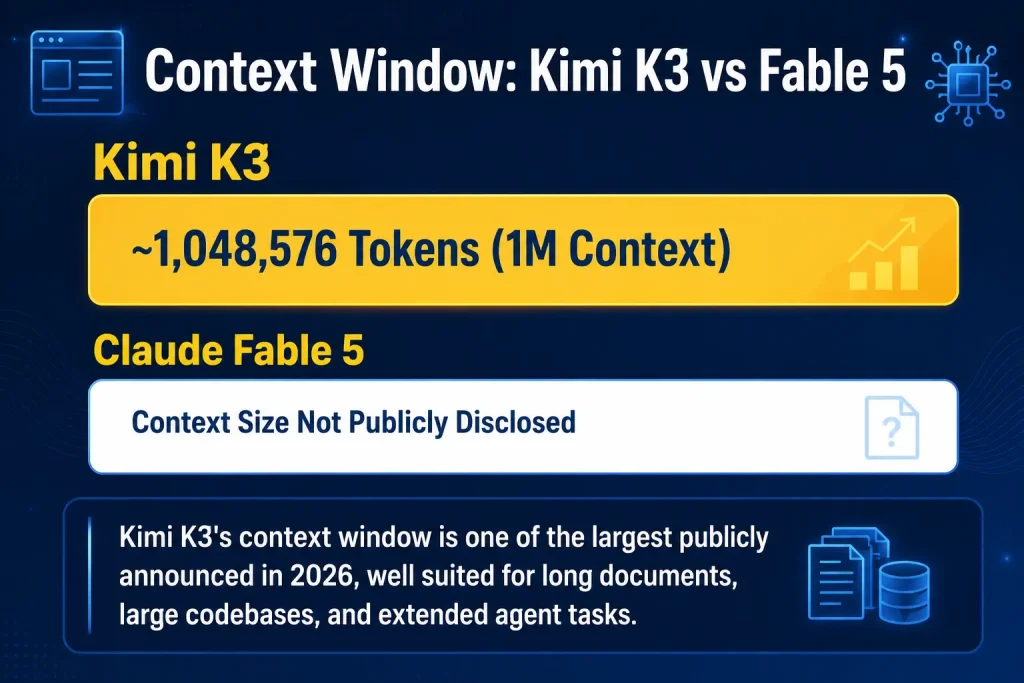
Kimi K3’s 1-Million-Token Context Window
Notably, Kimi K3 has a context window of 1,048,576 tokens. This is massive, because it means that the model can handle a lot of text data, code, or documents in one go, without having to split them up into smaller pieces.
In order to get the full 1M-token length, the developer has to change the context window parameter on the third-party agent tools when using K3, although the default value on some platforms may be less.
Long-Horizon Task Handling
This is a large context window that is directly leveraged by K3 in addressing long-horizon tasks such as the SWE Marathon benchmark. There is more information that could be available, which would allow the model to maintain a longer memory over the course of a long coding session or research task.
Here, Moonshot’s KDA architecture also makes a difference as it allows to lower the memory overhead that is typically required to support such a large context, making the long-context mode more practical to implement in real use, at scale.
Practical Implications for Developers
A large context window is helpful for a lot of things, such as looking at the whole codebase, reading long legal or technical documents, or performing content audits across multiple files. This can be a huge batch of keywords for an SEO specialist, or a lengthy draft for content.
However, paper context window size often differs from real-world. The long-context scores of K3 have been seen to be more sensitive to particular modes, such as when context compaction occurs, and so actual scores may be different depending on particular setup.
Which Model Should You Choose Kimi K3 vs Claude Fable 5?
Best Use Cases for Kimi K3
For teams who require a very big context window for long documents, an open weight model that can be self-hosted, or want long running coding/agent tasks perform well and at an affordable price, Kimi K3 is the right fit.
Best Use Cases for Claude Fable 5
Overall, Claude Fable 5 is the more powerful model for teams that require the highest general capability, prefer a model with more safety-focused design, or already use Anthropic’s ecosystem, such as the Claude Platform or Claude Code.
Cost and Accessibility Considerations
For high volume use-cases, Kimi K3’s API pricing may be a factor. Fable 5, on the other hand, is the reliable one, and has the backing of an established, well-supported frontier model, albeit it was briefly suspended for access due to export controls earlier this year before it was restored.
Conclusion
Kimi K3 vs Fable 5 demonstrates the new level of competition between China and the United States in the field of AI. Kimi K3 impresses with its massive context window, open-weight approach, and strong coding and agent benchmarks – even outshining models such as Claude Opus 4.8 in some tests. However, Moonshot’s own comparisons give a slight advantage to Claude Fable 5 in terms of the overall ability. It is up to you to decide which one is the one you need and what is important for you: it can be the performance, it can be the open weight (flexibility), it can be the context window size or it can be the cost. These are both tangible advances in the capabilities of AI in 2026.
FAQs
1. Is Kimi K3 better than Claude Fable 5?
Not overall — Moonshot itself says Kimi K3 trails Claude Fable 5 on general performance, though K3 beats other models like Claude Opus 4.8 on some coding and agent benchmarks.
2. What is Kimi K3’s context window size?
Kimi K3 has a 1,048,576-token (roughly 1 million token) context window.
3. Is Kimi K3 open source?
Yes, Kimi K3 is open-weight, with full model weights scheduled for release by July 27, 2026.
4. Can developers access Claude Fable 5 via API?
Yes, Claude Fable 5 is available through Anthropic’s API and Claude Platform.
5. Which model is better for coding tasks?
Kimi K3 shows strong results on long-running coding benchmarks like SWE Marathon, but independent verification is still limited, so results can vary by use case.