Introduction
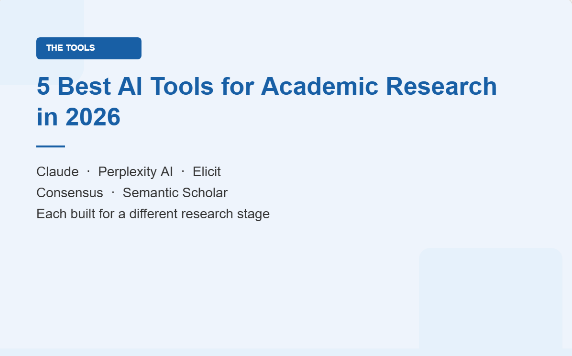
Academic research has changed a lot in the past few years. AI has become a part of daily life for students, professors, and researchers. However, there are still many users who are using ChatGPT for all things. You are not alone if you ever felt frustrated with wrong citations, outdated information or generic answers. Fortunately, there are smarter tools that have been designed specifically for research. In this article, we will discuss the best Chatgpt Alternative for research that will help you to work fast, get real-world research sources and more accurate results.
Table of Contents
Why ChatGPT Falls Short for Academic Research
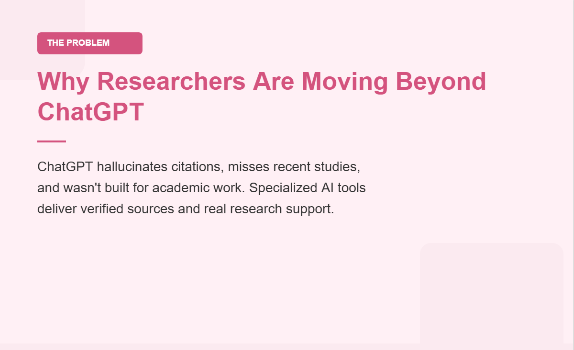
ChatGPT is a great general-purpose AI. Can write emails, clarify ideas, and think of ideas. However, when it’s time to do some serious academic research, it’s got its own weaknesses that can hinder you or even harm your research.
Hallucination is one of the major issues. ChatGPT occasionally invents fake citations that appear legitimate, but do not exist. It’s a serious problem for students and researchers. Giving fake references can harm your reputation.
ChatGPT might not always be able to access the newest research papers. It is only trained on data up to a certain point in time, so it might not be aware of recent studies that are relevant to your topic. This is a problem for fast moving fields such as medicine, technology, or economy.
Lastly, ChatGPT is a general tool. It was never designed for learners in the academic setting. It cannot read like specialized research tools, such as PRISMA workflow, systematic reviews, or databases with peer-reviewed articles.
What Makes a Good AI Research Tool?
It’s important to have a basic understanding of how to distinguish a useful research AI from a basic chatbot before beginning reading the list. The following is a list of some of the most important items to consider:
- The ability to use real academic papers and peer-reviewed sources.
- Accurate citations with links that can be verified.
- Capable of summarizing lengthy documents without missing important information
- Support for systematic reviews and literature analysis
- Open information sourcing (where you get information from)
5 Best ChatGPT Alternatives for Research
1. Claude by Anthropic
Claude is a Claude model created by Anthropic, and is best for reading and analyzing long documents.
Claude is one of the most robust AI solutions available for those who are doing research on lengthy documents. It is created by Anthropic and can deal with lots of text without dropping context.
Claude’s standout feature is its 200,000 token context window. In other words, you can upload an entire research paper or thesis, or even several papers at once, and Claude will read and understand them. However, most other AI tools forget the previous text in long discussions. Claude remains constant all along.
Another trait that Claude is known for is its ability to provide nuanced and thoughtful answers. It is NOT a regurgitator of information. It can analyze, compare, and synthesize content like a research assistant, not a chatbot.
Fast and optimal processing when looking at a large number of papers or literature review, comparing several research papers, noting similarities and differences, extracting key points, etc.
Best for: Literature review, long document analysis, comparing multiple research papers
Free plan: Yes — Claude.ai offers a free tier
Paid plan: Claude Pro starts at $20/month
Limitation: Does not search live academic databases on its own
2. Perplexity AI
With its ability to provide quick, accurate, and cited answers, Perplexity AI has emerged as one of the most sought-after tools for researchers. Perplexity works differently from conventional AI chatbots, which are trained with outdated data. Unlike traditional AI chatbots that are fed with outdated data, Perplexity is powered by live web search and real-time information retrieval.
All Perplexity’s answers come with citations that are linked to the response. You can clearly identify the source of information. It is extremely simple to check facts or trace information back to the original article or paper.
Perplexity also permits you to search certain sources such as academic papers, YouTube content, Reddit discussions, and live websites. This kind of flexibility gives it a more human-like feel than a chatbot while maintaining the functionality of a smart search engine for researchers.
Best for: Quick fact-finding, sourced answers, current events research
Free plan: Yes — generous free tier available
Paid plan: Perplexity Pro at $20/month
Limitation: Not specialized for systematic reviews or clinical research
3. Elicit
Elicit has been developed especially for academic research. It isn’t a conventional chatbot. The sole purpose of its existence is to aid researchers in the search, analysis and summarization of scientific literature in an organized fashion.
Search more than 138 million scientific publications and 545,000 clinical trials. It also implements semantic search, so you don’t have to include the right words to be able to find relevant studies. You can articulate your research question in natural language and Elicit will locate papers that are similar in meaning to your question.
It offers a useful feature that is data extraction. Elicit can review up to 1000 papers at once and extract main results, methods and conclusions and present them in a tabular structure. This facilitates one to compare studies side by side with ease.
Elicit also provides you with sentence-level citations from the papers it can find for each AI-generated claim. This allows you to have a clear idea of how the study has been stated at all times.
Best for: Systematic reviews, meta-analyses, evidence synthesis
Free plan: Yes — limited free tier
Paid plan: Plus plan at $12/month (billed annually)
Limitation: Focused mainly on scientific literature; not ideal for general queries
4. Consensus
Consensus is an AI-driven academic search engine tool that helps you find evidence-based answers, directly from peer-reviewed research. Don’t get a chatbot-answer, Consensus refers to real published research and says what science indicates.
It is particularly beneficial when beginning a research project to gain an overall understanding of what is already known about a topic. You pose a question in plain-English and Consensus searches for peer-reviewed papers that are relevant to your question, and summarizes the results for you.
Consensus is also a good indicator of whether a claim is backed by science, in a flash. Rather than reading through dozens of papers yourself, you can simply ask Consensus and have a summarized answer in seconds.
Best for: Evidence-based Q&A, early-stage literature exploration
Free plan: Yes — free plan available
Paid plan: Premium at $8.99/month (billed annually); student discount available (40% off)
Limitation: Not ideal for deep, multi-paper data extraction.
5. Semantic Scholar
Developed by the Allen Institute for AI, Semantic Scholar is a completely free AI-powered research database. It contains an index of more than 200 million academic papers in virtually all research areas.
The mark of distinction for Semantic Scholar from a standard academic search engine is that it utilizes AI to uncover links among papers. It presents you with citation networks, identifies the most influential work in a field and suggests further papers that might be of interest if you are reading a particular paper. This is helpful to delve into a subject deeply without missing out on any important studies.
Paper summaries and highlighting the important findings will also be provided by Semantic Scholar, allowing you to decide if a paper is worth reading in full. It’s one of the best free tools for the researcher with a limited budget or just beginning the research process on a particular topic.
Best for: Paper discovery, citation mapping, exploring new research areas
Free plan: 100% free — no paid plan needed
Limitation: Does not extract or synthesize data across multiple papers automatically
Quick Comparison Table
| Tool | Real Sources | Free Plan | Citations | Best For | Starting Price |
| Claude | Partial | ✅ Yes | Partial | Long doc analysis | $20/mo |
| Perplexity AI | ✅ Yes | ✅ Yes | ✅ Yes | Real-time research | $20/mo |
| Elicit | ✅ Yes | ✅ Yes | ✅ Yes | Systematic reviews | $12/mo |
| Consensus | ✅ Yes | ✅ Yes | ✅ Yes | Evidence-based Q&A | $8.99/mo |
| Semantic Scholar | ✅ Yes | ✅ Free | ✅ Yes | Paper discovery | Free |
How to Choose the Right Tool for Your Research
The same tool isn’t required for all researchers. It depends on the stage of research and most common type of work. This is a simple explanation:
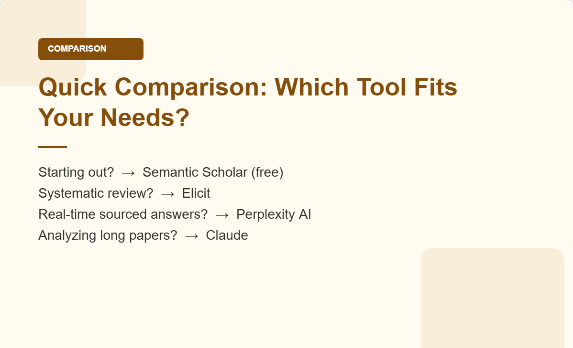
- Exploring what’s available when starting a new research? Get a quick overview using Semantic Scholar or Consensus.
- Carrying out a systematic literature review or a meta-analysis? Elicit is designed to do just this.
- Need answers from sources and in real time with links you can check? Perplexity AI is the most suitable choice.
- Reading and analyzing long documents or several full length papers? Claude does a better job of this than any other tool.
- Need a budget-friendly solution? There is no fee to use Semantic Scholar and both Elicit and Consensus have good free levels.
The best way to do this is to use two or three of these tools. For instance, you can use Elicit to discover fitting papers, upload the most effective ones to Claude for profound analysis, and use Semantic Scholar to check the connections between your citations..
Tips for Using AI Tools Effectively in Academic Research
While AI tools can save you hours of work, they can only do so when used correctly. Here are some suggestions to keep in mind:
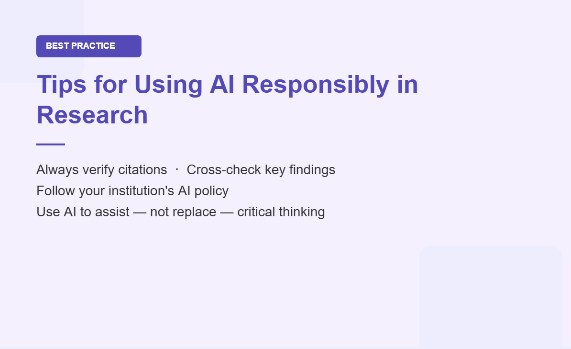
- Always check the accuracy of citations created by AI before using for academic assignments. Even the best tools can make mistakes.
- Utilize AI tools for drafting and structuring ideas, but not to replace your own critical thinking.
- Review your institution’s policy on the use of AI. There are now guidelines from many universities regarding the use and when the use of these can be allowed.
- To confirm key findings from more than one instrument, cross-check them.
- Summarize and discover with AI, but read papers that are most relevant to your argument yourself.
Conclusion
The right chatgpt alternative for research can fundamentally upset your work. So, whatever your role is, whether you’re a student beginning your first literature review, a PhD researcher with thousands of papers to keep track of, or an academic professional who needs information quicker and easier, there is a tool on this list that fits your needs. Claude is excellent for deep document analysis, Perplexity can provide sourced real-time answers, Elicit is great for systematic reviews, Consensus is great for evidence-based questions, and Semantic Scholar can discover free papers. Choose the tool that is right for you at this research stage, and don’t hesitate to use two or more tools for maximum results.
FAQs
Q1. Can ChatGPT be rivaled by any other AI in the area of academic research?
Yes. In the realm of academic research, there are tools such as Elicit, Consensus, and Perplexity AI that are more effective than ChatGPT. They are built for searching actual academic databases, cite sources, and deliver fact-based responses: something that ChatGPT can’t always do.
Q2. What is the AI research tool that offers 100% free access?
There is no paid plan for Semantic Scholar, it’s free. It aggregates more than 200 million academic research papers and AI-powered relevant papers, paper networks and paper summaries without any charges.
Q3. Is it safe to do research using AI tools and not plagiarize?
Yes, but with assistance from AI for thinking, not repeating. Paraphrase and check information sources, and give credit to original sources correctly. Most universities tolerate AI research but mandate complete transparency and oversight by humans.
Q4. Can Claude outsmart ChatGPT in reading research papers?
Claude is typically superior to ChatGPT when reading and analyzing long research papers. In the academic context, Claude’s ability to understand large portions of text with its 200,000 token context window can significantly improve analysis of entire papers or multiple documents, as it can maintain a broader context of what has occurred before. For detailed academic analysis, Claude’s 200,000 token context window can really help when reviewing large chunks of text, namely several documents or whole papers, because it can maintain a broader context of what has come before.
Q5. Is Google Scholar going the way of Yahoo and Yahoo! Messenger?
Not completely, but they can fit in nicely! Research tools such as Semantic Scholar and Elicit can summarize results, extract key data, and guide you through synthesizing information from numerous papers – more than Google Scholar can do. But Google Scholar is still a reliable and complete database that should be used in conjunction with these AI tools.