Introduction
ChatGPT transformed the internet usage. It helped to make AI simple, fast, and helpful to all. However, with the increasing number of people using it every day, a number of people are seeking something new or better. Others would want privacy, others would want search in real-time, and others would want an improved code generator or writing programs. The positive side is that the AI world has increased significantly in 2026. Now you have numerous powerful tools that ChatGPT is unable to do. This article will discuss the 10 Best Alternate of ChatGPT, enabling you to select the appropriate tool to use.
Table of Contents
What to Look for in an Alternate of ChatGPT
It is always good to know the characteristics of a good ChatGPT alternative before leaping off the list. All AI tools are not constructed in the same manner. They all possess their merits.
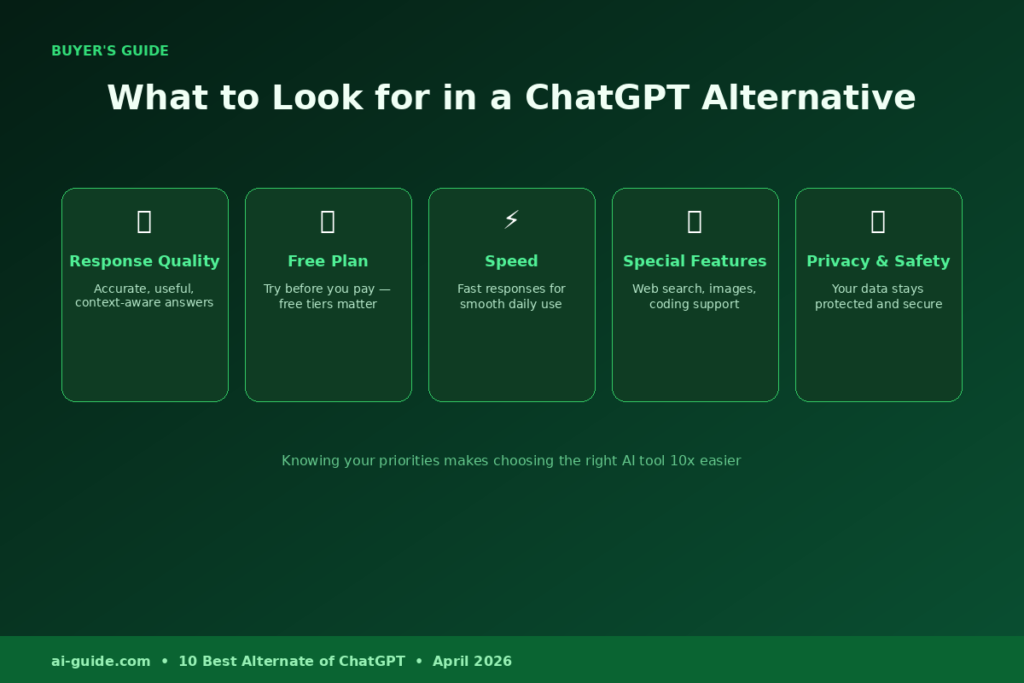
The following are some of the main things to look:
- Response quality – Does it provide useful, correct responses?
- Availability of a free plan – Does it allow you to use it free?
- Speed- Does it react quickly enough to be used every day?
- Special features – Does it provide web search or image reading or help with coding?
- Privacy- Does it protect your information?
After knowing your needs, it will be a lot easier to select the right tool.
Top 10 Alternate of ChatGPT in 2026
1. Claude AI
Claude is an AI created by Anthropic and one of the most powerful AI tools currently. The responses provided by Claude are more human-like and many users prefer it over other AI as a creative writing tool because it is a favorite among writers, creatives, and any other party interested in the best AI to use when writing creative works.
Main Characteristics: Claude is distinguished by a huge memory. It is able to process and store data in documents of exceptionally high length- up to 150,000 words per time- which is akin to reading a whole book at once. The Claude Opus 4.6 is also now in a position to serve a context window of 1 million tokens to the enterprise.
Pricing: Free plan available. Claude Pro costs $20 per month.
Best Uses: Writers, students, lawyers and those who deal with long documents.
Pros: Human-like tone, supports long texts well, has excellent code support
Cons: The Opus model may be costly to API users.
2. Google Gemini
Google Gemini is a multimodal artificial intelligence assistant designed to provide access to real-time information and integrates with Google products, which can support text, image and voice interactions.
Major Strengths: Gemini can be most effective when the simple work becomes technical and you are already living within the ecosystem of Google, particularly in the cases of coding, research, or solving a multi-step problem. The new Gemini 3.1 Pro now has a context window of 1-million-tokens and it understands text, audio, images, and video.
Pricing: Free plan. Gemini Advanced is priced at 19.99/month.
Best For: Developers, researchers, students and Google Workspace users.
Pros: Deep Google functionality, real-time search, multimodal support
Cons: Not as useful when you do not use Google tools.
3. Microsoft Copilot
Microsoft Copilot is an enterprise-based AI assistant that integrates extensively into Microsoft 365 apps. It assists professionals to automate documents, emails, meetings, and data analysis based on the organizational context.
Key Features: Copilot is integrated into Word, Excel, Outlook and Teams. This is why it is the simplest AI tool to operate in case you already operate within the Microsoft ecosystem. It is able to summarize meetings, draft emails and make presentations in a few seconds.
Pricing: Bing offers a free plan. The Microsoft 365 Copilot is available in business at a starting price of $30/per person/month.
Best Applicants: Office users, business teams and corporate users.
Pros: Full integration with Office 365, user-friendly, highly productive
Cons: Full functionality needs a paid plan of Microsoft 365.
4. Perplexity AI
Perplexity is a search engine that uses real-time web search to combine the power of large language models with conversations. It does not merely give you links as it reads the web and provides you with sourced, cited answers.
Main Characteristics: Perplexity demonstrates its work when you need facts and not opinions. Each statement is connected to a reference. You may navigate and check. This renders it very helpful to students, reporters and researchers who require reliable information.
Pricing: Free plan. Perplexity Pro is a paid service with a price of 20 USD per month with 300+ Pro searches and unlimited file uploads.
Best For: Researchers, journalists, fact-checkers, and students.
Pros: It referenced all the sources, real-time access to the web, and it is simple to check facts
Cons: It is not as good as creative writing or an ordinary conversation.
5. DeepSeek
DeepSeek is a Chinese open-source AI model that rocked the world when it was released in early 2025. As V4 MODEL1 architecture has achieved 1.8x inference speeds and a 40% reduction in memory, it has emerged a true leader in multiple categories.
Noteworthy Features: DeepSeek is an open-source software, and this allows it to be run by the developers themselves. DeepSeek V3.2 is priced at the lowest point of 0.28/ million input tokens and surprisingly competent at the fraction of flagship price and 90 percent cache discounts allow repeated-context workloads to be virtually free.
Pricing: No cost as long as the web app is utilized. Extremely low API pricing to developers.
Best When: Technicians, coders and developers require a less expensive option.
Pros: Free and open-source, highly inexpensive API, good performance on code Cons: Not so user-friendly, servers located in China.
6. Grok
Grok is created by the AI company of Elon Musk. It has a strong association with the X (previously Twitter) platform that provides it with a particular edge in real-time information.
Key Features: Grok is most important when live X context is at the heart of the workflow. A 2-million-token context window is also supported in Grok 4, which is one of the largest available. It is excellent in following the trending topics and the happenings in real time.
Pricing: X Premium+ can be used at a monthly price of $22.
Best Use: Journalists, social media managers, and others requiring real time trend data.
Pros: Real-time X/Twitter feed, massive context window, rapid feedback
Cons: It must be subscribed to X Premium, not oriented towards work-related activities.
7. Meta AI
Facebook, Instagram, WhatsApp, and Messenger have their own meta AI. It is also one of the simplest AI tools to use since majority of the population uses these apps on a daily basis.
Main Characteristics: Within your preferred social applications, you can pose Meta AI questions directly. It may aid in writing captions, responding to questions and creating images. It adopts Llama model, which is also open and the one that is common with the developers.
Pricing: Completely free to use.
Recommended to: Casual users, content creators and social media managers.
Pros: 100% free, available within social apps, requires no additional registration
Cons: Not as powerful as Claude or Gemini to do intense work.
8. Jasper AI
Jasper AI is a complete marketing content platform. It is designed with marketers, bloggers and content teams in mind who have to generate a lot of written content on a regular basis.
Core Competencies: Jasper is able to create blog posts, ad copy, email campaigns, and social media content. It maintains your brand voice throughout the content. It also includes inbuilt SEO features which can be used to rank your content higher in Google.
Pricing: Begins at 49/month. No permanent free plan, but a free trial is available.
Best For: Marketing teams, content agencies and regular bloggers.
Pros: Brand voice control, SEO tools, team-friendly
Cons: High cost in comparison with other tools, no free plan.
9. YouChat
You Chat is a subsidiary of You.com search engine. It is an AI chatbot paired with a classic search engine that is available in one place.
Major Strengths: YouChat is able to search the web in real time as well as hold a conversation with you. It also allows several AI models and displays source links to each answer. It is a fantastic daily utility to individuals who desire to search and chat together.
Pricing: Free plan. YouPro plan starts at $20 per month.
Best Uses: Everyday users who desire search + AI in a single tool.
Pros: In-built web search, a variety of AI models, user-friendly
Cons: Less recognizable, less sophisticated than Claude or Gemini.
10. Mistral AI
Mistral AI is a French AI company that has created some of the most efficient open-source language models. The most popular open-weight products are Llama and Mistral, which provide self-hosting and control of the infrastructure to the teams.
Features: Mistral products are light, fast and may be configured to run locally on your own computer or server. This is why they are recommended to those users and developers who prioritize their privacy and have complete control over their AI. Mistral API is affordable as well.
Pricing: Self-hosted and free of charge. The price of API begins at $0.10 per million tokens.
Best Use: Developers and privacy users and open source users.
Pros: Open-source, fast, cheap API, self-hostable
Cons: Not as easy to set up on-premises as it needs technical expertise.
Quick Comparison Table
| Tool | Best For | Free Plan | Unique Feature |
| Claude AI | Writing & Long Docs | ✅ | 1M token context window |
| Google Gemini | Google Ecosystem | ✅ | Multimodal + real-time search |
| Microsoft Copilot | Office Productivity | ✅ | Deep Office 365 integration |
| Perplexity AI | Research | ✅ | Cited, sourced answers |
| DeepSeek | Budget Coding | ✅ | Ultra-cheap API pricing |
| Grok | Live Trends | ❌ | Real-time X/Twitter data |
| Meta AI | Social Media | ✅ | Built into social apps |
| Jasper AI | Marketing Content | ❌ | Brand voice + SEO tools |
| YouChat | Search + AI Combo | ✅ | Search engine built-in |
| Mistral AI | Open-Source Dev | ✅ | Self-hostable models |
Which Alternate of ChatGPT Is Right for You?
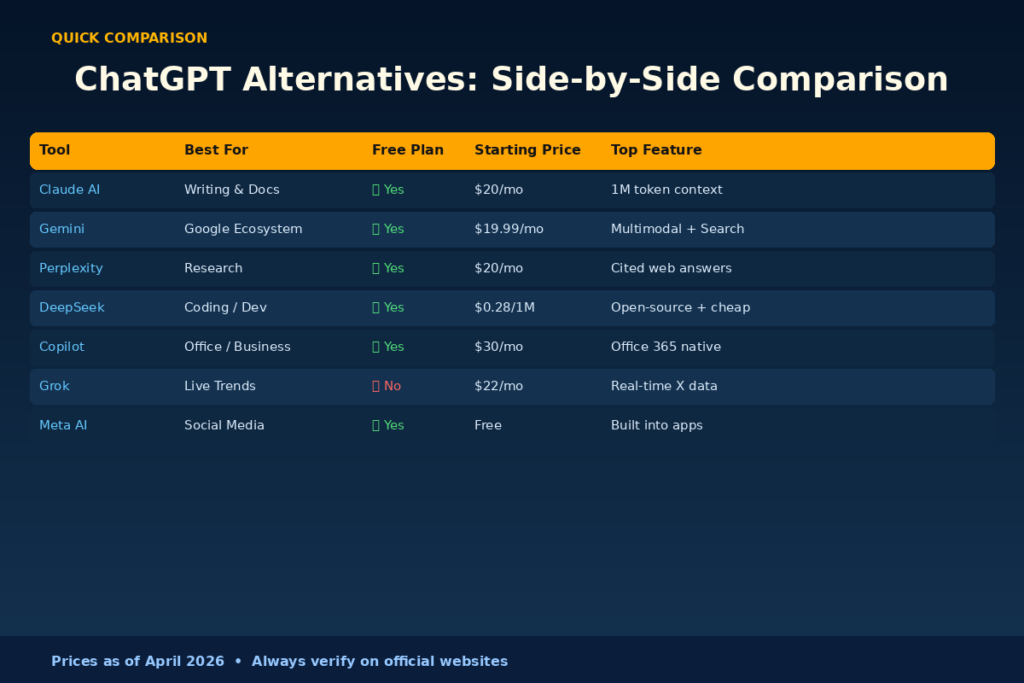
The selection of the most appropriate tool is based on your activities. The following is a basic guide:
- Students and Researchers: Use Perplexity AI to get cited and reliable answers.
- Writers and Bloggers: Select Claude AI to write naturally and in a high quality.
- Developers & Coders: Code support Excel with DeepSeek or Claude.
- Business and Marketing Teams: Try Jasper AI or Microsoft Copilot.
- Casual and Social Media Consumers: Don’t leave Meta AI — it is free and simple.
- Budget Users: Claude and Gemini are free and DeepSeek are awesome.
The most suitable would be to begin with the free plan of two or three tools and evaluate which one would suit you.
Conclusion
The AI space in 2026 is more exciting than ever. No single tool can be used to suit all people anymore. No matter what field you are in, whether it is as a student, a developer, a marketer, or simply someone who is interested in AI, you will find your ideal tool on this list. With Claude, with his strong writing capabilities, and Perplexity, with its research capabilities, and DeepSeek, with its low-budget API, each has something to offer. Test out some of the free plans, experiment with the functionality, and choose the one that fits your everyday workflow. The 10 Best Alternate of ChatGPT that are presented here are all tried, tested and updated to April 2026 – so you are in good hands.
FAQs
Q1. What will be the most suitable free alternative of ChatGPT in 2026?
Some of the best free options are Claude AI and Perplexity AI. Claude provides good writing and document support and Perplexity provides cited, real-time search answers, both entirely free on their base plans.
Q2. Is Claude AI better than ChatGPT?
Claude is better than ChatGPT to write, produce long documents, and converse naturally with many users. Nevertheless, ChatGPT continues to be a leader in general-purpose tasks, image generation, and its broader selection of built-in tools.
Q3. What is the best ChatGPT alternative to use in coding?
Both Claude AI (Sonnet 4.6 and Opus 4.6) and DeepSeek V3.2 are good choices to code in 2026. Complex tasks are better with Claude, whereas DeepSeek is much less expensive to developers at scale.
Q4. What is the most appropriate AI tool among students?
The best option among AI systems is perplexity AI since it has referenced all the sources, and it is simple to validate the information and apply it to academic tasks. Google Gemini is also very good in research and integration with Google Docs.
Q5. Are these ChatGPT alternatives safe?
The majority of the large tools such as Claude, Gemini, and Perplexity have a strict privacy policy and do not train with your data on their paid plans. To ensure the highest level of privacy, open source, such as Mistral AI and DeepSeek can be hosted on a personal server.