
Introduction
Google DeepMind has unveiled a new AI model, Gemini 3.5 Flash Cyber, specifically designed for detecting, verifying, and repairing software vulnerabilities. It will be released on July 21, 2026, along with two other new Flash models, and is an effort to switch to smaller, more purpose-built AI systems instead of just massive general purpose AI models for cybersecurity tasks. The model is fine-tuned for finding and fixing cybersecurity vulnerabilities at a competitive price point, and is exclusively available to governments and trusted partners through a limited access pilot program. This article explains the model’s functions, its performance and its user.
Table of Contents
What Is Gemini 3.5 Flash Cyber?
Gemini 3.5 Flash Cyber is a customized variant of Gemini 3.5 Flash, designed with a focus on identifying and mitigating cybersecurity risks, with reduced token costs compared to its larger counterparts. Whereas it’s not a general-purpose chatbot or coding assistant, it’s here to serve one purpose well – search out security vulnerabilities in software before hackers can.
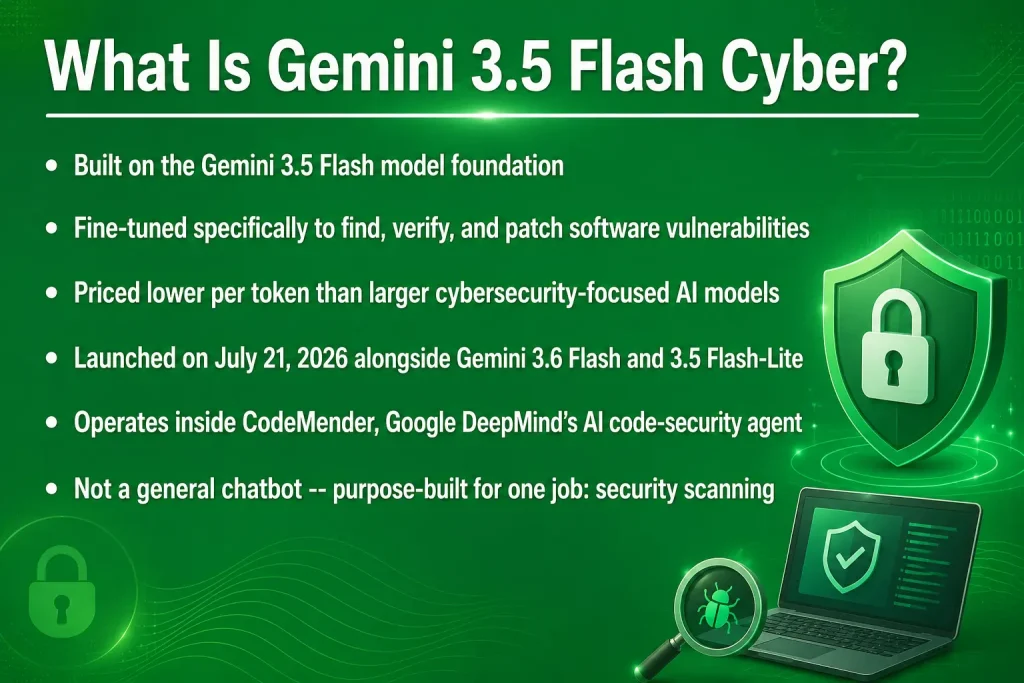
The model is based on the Gemini 3.5 Flash architecture and balances performance, speed and cost-effectiveness over raw scale, making it well suited for deployment over large scale. This is very significant in cyber security, where scanning large codebases involves looking at a large number of possible paths to execution. The high cost of a single call to a large model can be limiting if speed is critical.
Launched on July 21st, 2026, with the releases of Gemini 3.6 Flash and 3.5 Flash-Lite, this is the most unique of the three releases. It’s not on a public page and most developers won’t be able to access it directly. Yes, that’s intentional and I’ll explain why later in this article.
Gemini 3.5 Flash Cyber in CodeMender
What CodeMender Is
Gemini 3.5 Flash Cyber doesn’t work alone. It runs within CodeMender, Google DeepMind’s AI agent specifically designed for code security. Let’s think of CodeMender as the system that encases the raw model and makes it usable, just like an AI model is wrapped by a customer support system and becomes a working customer support system.
CodeMender hosts several Gemini 3.5 Flash Cyber agents concurrently to discover, validate and patch vulnerabilities and collates the results into a unified report. This agent is already being used with some of Google’s most popular code bases, providing a real-world test bed away from the lab.
The Multi-Agent Approach
Vulnerability hunting is indeed a search problem — scanning through huge codebases involves traversing a huge number of execution paths, and using just one expensive API call to a large model is a bottleneck. CodeMender’s answer was an ingenious one: Google’s offering was a large, expensive model doing all the work, so CodeMender calls the smaller, cheaper Flash Cyber model several times.
In response to the absence of a single agent to handle the bottleneck, CodeMender uses 3.5 Flash Cyber multiple times to analyze significantly more code paths in parallel to generate a single high-quality vulnerability report. This design is particularly advantageous for frequent scanning, short development cycles, line-by-line code review, and other scenarios.
Why This Design Choice Matters
This approach challenges a common assumption in AI: that bigger models are always better. Flash Cyber’s release contains a technical argument about model size that runs against much of what the industry has been saying. A smaller, specialized model called several times can match or beat a giant model called once — at a fraction of the cost.
Benchmark Results and Real-World Performance
CyberGym Benchmark Scores
In Google’s own report, using Gemini 3.5 Flash Cyber inside CodeMender has yielded a 83.2% accuracy rating on CyberGym, which puts it in the competitive range with frontier security agents from OpenAI and Anthropic. Although it was not the highest score on the list, the score was fairly grouped.
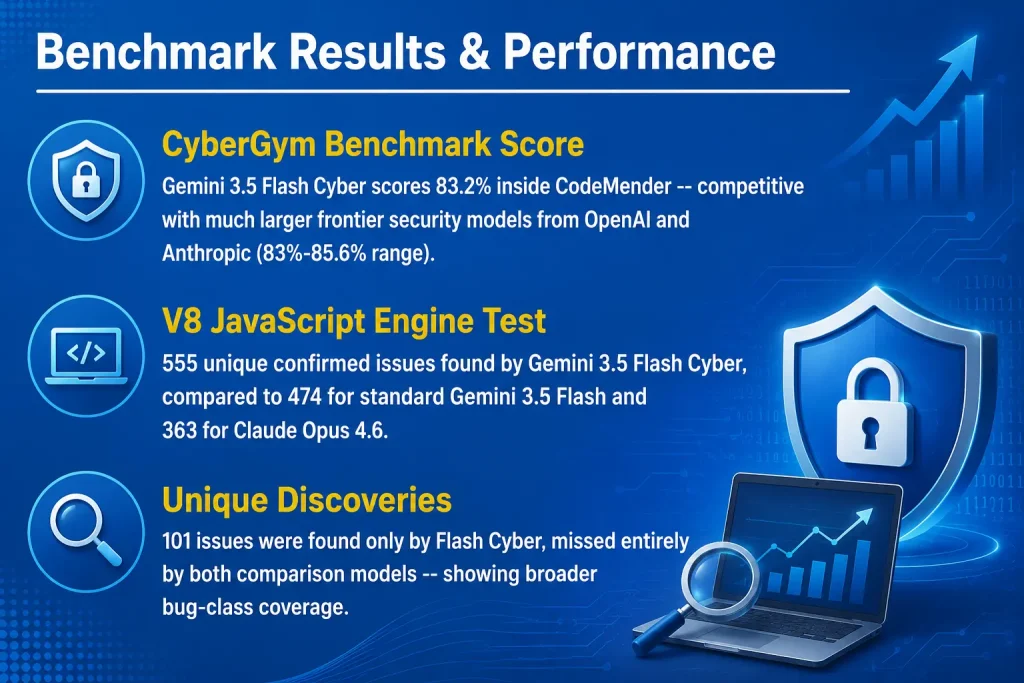
The average percentage scores for frontier agents were between 83% and 85.6%, and despite the much smaller and lower cost model, Flash Cyber still came out in this range. That’s a pretty solid performance against much costlier contestants for a light, low cost system.
V8 JavaScript Engine Test Results
The more detailed was a test with the Chrome’s V8 JavaScript engine, which is a very complex chunk of software. Over a set number of evaluations, Gemini 3.5 Flash Cyber found 555 unique confirmed issues, while standard Gemini 3.5 Flash and Claude Opus 4.6 found 474 and 363 respectively.
Google said that 101 of the 121 problems Flash Cyber found were not detected by either of the comparison models, meaning the cyber-tuned version doesn’t appear to repeatedly highlight the same sort of flaw. This is important because it consumes time to find the same bug again, but it is good to find new bug classes to increase security coverage.
Real-World Deployment
In addition to lab benchmarks, the model is already being used. Google’s internal codebases at Chrome, Android, Cloud, Ads and YouTube are all affected by 3.5 Flash Cyber. This is not a theoretical exercise — it’s scanning software that billions of people use daily.
The RCE Exploit Discovery Case Study
One of the most impressive applications of the model’s ability was Google’s own security team. In two hours, Google’s Cloud Vulnerability Research team identified a memory-corruption defect in a critical production service and identified remote code execution vulnerabilities in public APIs using the model.
That was pretty quick, but what happened next garnered even wider eyebrows. The model then created a fully reliable exploit for the remote code execution vulnerability, which it passed over such defenses as ASLR and W^X. The two most frequently exploited defense mechanisms to thwart attacks using memory-related bugs.
The model is said to generate a flawless (100%) remote code execution attack, which was able to overcome the basic defenses such as Address Space Layout Randomization and Write XOR Execute. Simply put, the AI was not only able to see the weakness, it found it and it was actually vulnerable because it was able to break through a regular defense.
It’s actually this two-in-one power — discovering bugs and showing they can be exploited — that’s why Google is taking it easy on the availability of this model.
Who Can Access Gemini 3.5 Flash Cyber
Limited Pilot Program
This limited access pilot program will be available only to governments and trusted partners to obtain Gemini 3.5 Flash Cyber. This is not the same as the majority of AI models that are released to a developer with an API key just after they’re launched.
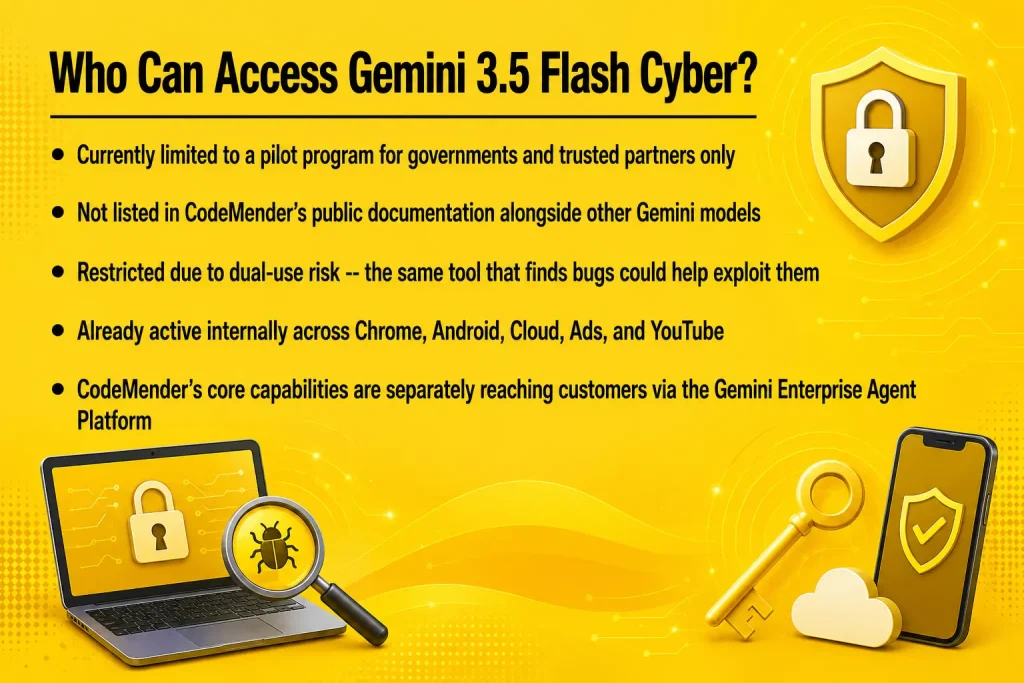
The current CodeMender documentation lists Gemini 3.5 Flash, Gemini 3.1 Pro Preview, and Gemini 3 Flash Preview as available models, though there’s no documentation of Flash Cyber. For code developers who are using CodeMender regularly, the model isn’t available today.
Why Google Is Being Cautious
Because of the dual-use nature of the technology, Google has made a conscious decision to only provide 3.5 Flash Cyber to governments and trusted partners through CodeMender, and limited the access to a pilot program. The term to use is “dual-use” — a tool used to discover and repair vulnerabilities can also be used to discover and exploit vulnerabilities.
The RCE example above is a good explanation of why this caution is appropriate. For defenders, a model that can generate an architecture of an operational exploit without any assistance from anyone is very powerful, but for the attackers, it can be very dangerous.
Broader Access through CodeMender
However, access is not totally shut down. Google is also launching new versions of the core features of CodeMender directly to customers through generally available (GA) Gemini models, which will leverage Gemini Enterprise Agent Platform. Although the specialized Cyber model is not yet available for businesses, other Gemini models are available today that can be used for similar code-security workflows.
Gemini 3.5 Flash Cyber vs. Security AI
Google isn’t the only big AI lab experimenting with automated vulnerability discovery. Like Anthropic and OpenAI, both have security research programs, and Google has tested 3.5 Flash Cyber with similar techniques to find remote code execution and memory-corruption vulnerabilities.
It’s not about raw power; it’s about efficiency — that’s what makes Flash Cyber different. Google didn’t aim to create the most powerful security model, but rather a smaller one, multiple times via an agent framework. This will ensure it remains competitive on benchmarks and is not too costly to be scanned only occasionally, but rather regularly, on a daily basis.
The Future of AI Cybersecurity
It’s not only about the benchmark scores of the model; the bigger story behind Gemini 3.5 Flash Cyber is that. It’s a red flag that means that security is becoming a true arms race, where both attackers and defenders may have tools.
Defenders can benefit from tools such as CodeMender, which has the potential to provide speedier, more cost-effective and more regular vulnerability scanning that can detect issues during regular code commits — not months later. It poses genuine industry concerns about access, monitoring, and the rate at which these capabilities might become ubiquitous, not just in controlled pilots but across the broader industry.
Google has hinted that this will be gradually expanded in the months ahead, but without a strict deadline. This is a tool that is very much under scrutiny for now, from both security researchers and policymakers and other AI labs.
Conclusion
With just a handful of flashy features, Gemini 3.5 Flash Cyber is able to compete with much larger systems in the real world when it comes to the software vulnerability hunt. The model has come a long way from discovering hundreds of new bugs in Chrome’s V8 engine to creating its own working Chrome exploit that circumvented the typical security measures. However, it has a dual-use aspect, and Google continues to limit access to governments and trusted partners. This release is an important, closely-watched milestone in the increasing importance of AI in cyber security, as CodeMender’s capabilities increasingly spread to more customers via the Gemini Enterprise Agent Platform.
FAQs
1. What is Gemini 3.5 Flash Cyber used for?
It’s used to find, verify, and patch security vulnerabilities in software, working inside Google’s CodeMender agent.
2. Is Gemini 3.5 Flash Cyber publicly available?
No. It’s currently limited to a pilot program for governments and trusted partners.
3. How does Gemini 3.5 Flash Cyber compare to Claude Opus 4.6?
In Chrome’s V8 engine test, it found 555 confirmed issues compared to 363 for Claude Opus 4.6.
4. What is CodeMender?
CodeMender is Google DeepMind’s AI agent that uses multiple Flash Cyber agents to detect, validate, and patch code vulnerabilities.
5. Why is access to Gemini 3.5 Flash Cyber restricted?
Because it can both find and exploit vulnerabilities, Google is deploying it cautiously due to its dual-use potential.