Introduction
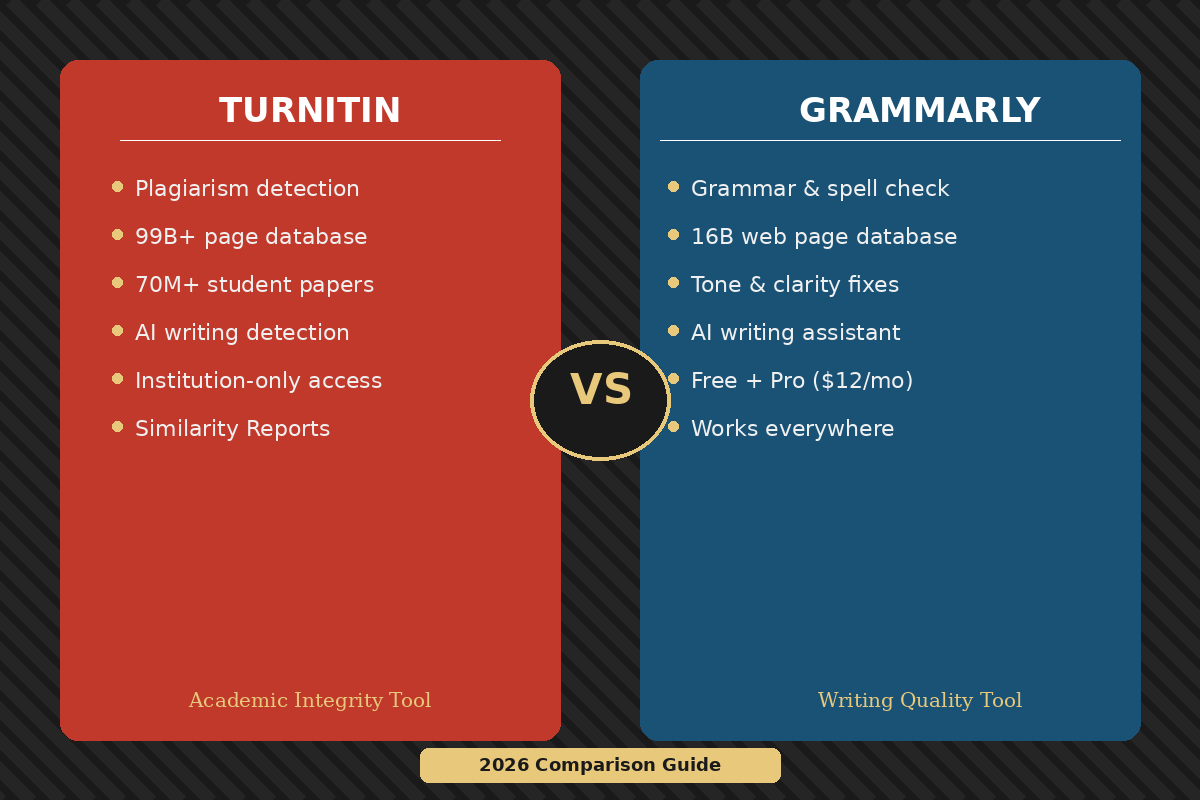
And, as a student with assignments and deadlines, have you likely not heard of Turnitin vs Grammarly, but do you know the difference between the two? Most students believe that these tools are doing the same task but this is a typical error that can earn you a penalty. Grammarly is a grammar checker that fixes grammar, tone, and clarity. Turnitin assures you that your work is original by analyzing your work against millions of academic resources. One perfects your writing. The other is its policed. Knowing just what each of the tools is and when to apply it can be the difference between academic success and a preventable case of integrity violation.
Table of Contents
What Is Turnitin?
Turnitin was established in 1998, and nowadays, the service is utilized by more than 16,000 educational establishments across the globe. It was constructed with only one main aim; ensuring that students present original work. It works by contrasting the text you submit to a gigantic database and creating a Similarity Report a percentage score who indicates how much of your paper is similar to existing sources.
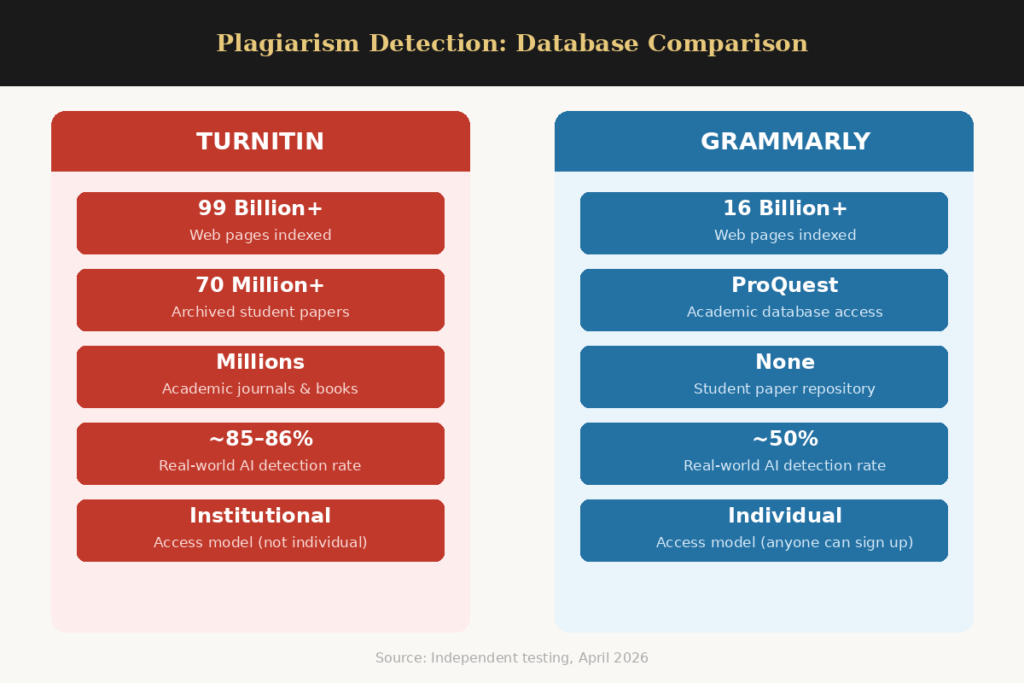
Turnitin is truly effective due to the richness of the database. It has more than 99 billion web pages, millions of scholarly journals and most importantly, it has more than 70 million student papers that had been submitted by students in various universities of the world. The latter is its distinguishing feature to all other tools. Turnitin is likely to detect if a student recycles an essay he or she submitted five years ago at different university.
Key Features of Turnitin
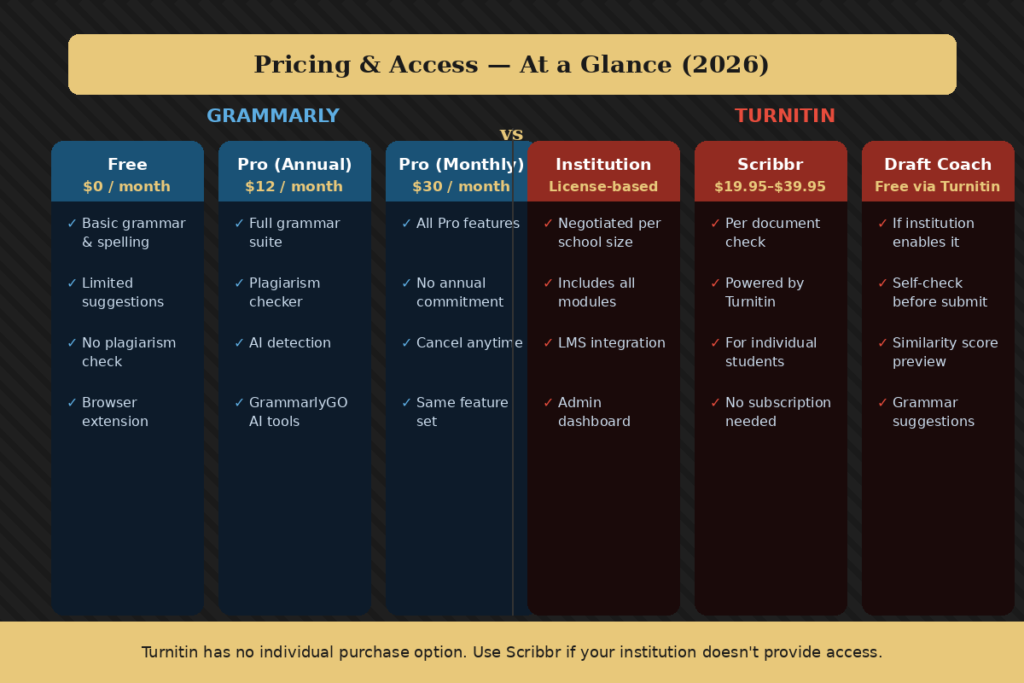
Turnitin has grown far beyond mere plagiarism checkers. Its features in 2026 will be color-coded Similarity Reports indicating the matching text, an artificial intelligence writing detector indicating the content that might have been created by such tools as ChatGPT, compatibility with most learning management systems (Canvas, Blackboard, Moodle), and a Feedback Studio where instructors can comment on their work and mark it. It can also provide a Draft Coach feature to ensure students check themselves before final submission in case it is allowed by their institution.
Important to Know
Turnitin is marketed to schools solely. You cannot purchase it as a single student. In case your university has it, you will have it on your course portal. Otherwise, Scribbr is available on a pay-per-use basis with Turnitin-based checks (a range of $19.95 to $39.95 per document).
What Is Grammarly?
Grammarly was started in 2009 and has since expanded to an active user base of more than 30 million per day students, professionals, and content creators, and non-native English speakers. Grammarly is not an academic integrity enforcer, unlike Turnitin. It is a writing helper. Its essence is to clarify, clean up, and simplify your writing.
It is real-time and it analyzes your writing in grammar, spelling, punctuation, tone, word selection and clarity of sentence as you type. Grammarly is available on hundreds of platforms, including Google Docs, Microsoft Word, email programs, and others, so that it can be conveniently used across the board of where one needs to write. In 2026, Grammarly has renamed its paid product tier as Pro, which now has team and business options in addition to the complete writing platform.
The main Characteristics of Grammarly
Grammarly Pro also provides grammar and spelling correction, tone and clarity recommendations, vocabulary improvement, a plagiarism detector (scans 16 billion web pages and ProQuest academic databases), an AI writing detector, and generative AI capabilities in GrammarlyGO, rewriting and brainstorming. The free version includes the basic grammar and spelling. The Pro plan begins with either a yearly plan of 12/month at 12 dollars or monthly at 30 dollars.
Turnitin vs Grammarly Comparison
Now that you understand what each tool does on its own, let’s put them side by side across the metrics that matter most for students and educators.
| Feature | Turnitin | Grammarly |
| Primary Purpose | Plagiarism & integrity detection | Writing quality improvement |
| Database Size | 99B+ pages + 70M student papers | 16B web pages + ProQuest |
| Grammar Checking | ✗ Not available | ✓ Core feature |
| Plagiarism Detection | ✓ Institutional standard | Limited (no student papers) |
| AI Detection Accuracy | ~85–86% (real-world tests) | ~50% (independent tests) |
| Individual Access | ✗ Institutions only | ✓ Anyone can sign up |
| Pricing | Institutional license only | Free / $12–$30/month (Pro) |
| LMS Integration | ✓ Canvas, Blackboard, Moodle | Limited |
| Best For | Educators & institutions | Individual students & writers |
Plagiarism Detection: A Big Gap Exists
This is where the two tools are most different. The Turnitin database contains past submissions of thousands of students in thousands of universities all over the world. The plagiarism detector of Grammarly scans only the publicly available web materials and covered academic resources with ProQuest. It just lacks the access to the archive of student papers submitted before.
The real-world impact is significant. In 2026, independent testing revealed that Grammarly scored a 0% similarity rating on documents with Turnitin scoring 64% similarity. Good Grammarly report does not imply your paper will pass Turnitin. In case your university operates with Turnitin, the plagiarism detector of Grammarly will provide minimal coverage as a pre-check option.
AI Detection: Neither Tool Is Perfect
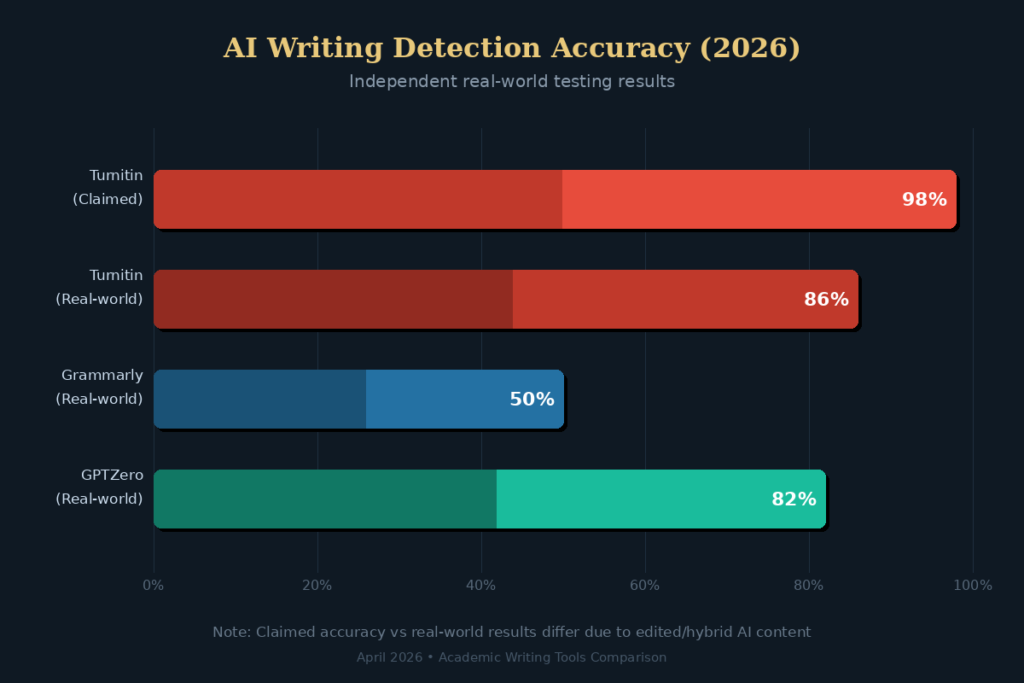
The two tools currently have AI writing detection, with each not being equally accurate. Turnitin states that it can achieve 98 percent accuracy on fully AI-generated text. But in 2026 independent tests estimated the real-world number to be nearer to 85 86% in consideration of edited or hybrid content. The AI detection of Grammarly has an approximately 50 percent accuracy in independent tests – it was not developed as an independent detector but rather as a secondary feature of a writing assistant.
Another problem worth being aware of is known. The AI detector of Turnitin will not be activated with the simple grammar and spelling corrections offered by Grammarly. Such types of edits are considered just like any other proofreading. However, when you extensively engage the generative AI features of Grammarly (like GrammarlyGO to paraphrase paragraphs or to rephrase an entire section) Turnitin might consider that text to be AI-generated, since the sentence structures are overly smooth and predictable.
The rule of thumb: Grammarly is correct, not create.
A clean Grammarly plagiarism score has no meaning to Turnitin, they are comparing totally different things to totally different databases.
Can You Use Turnitin and Grammarly Together?
Yes — and because it is in the best interest of most students, it is the wisest plan to use both. They do not compete tools. They are in a totally different section of your writing process. Grammarly enhances the quality of your work even before you post it. Turnitin (or Turnitin-like check) informs you that ideas themselves are original enough.
A Simple 3-Step Workflow
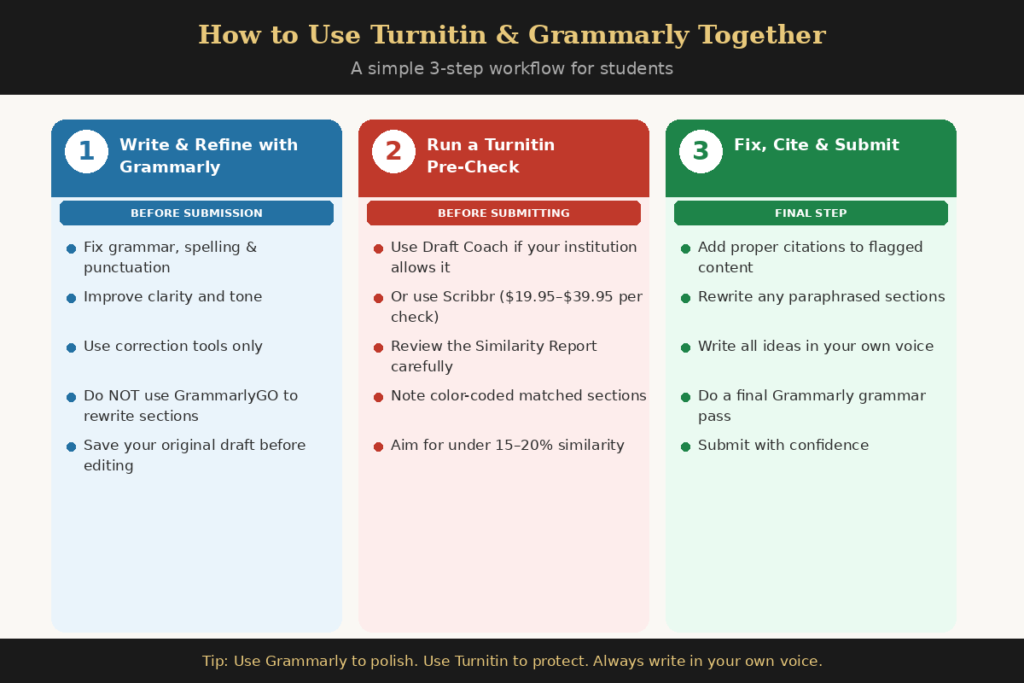
1. Write and refine with Grammarly
Fix grammar, use Grammarly to make it clear and change its tone. Use the correction tools, but not AI rewriters. This takes your draft to a finished form.
2. Conduct a pre-check of plagiarism
In case the similarity score is provided by Turnitin Draft Coach to your institution, use it to verify the similarity score before submitting finally. Otherwise, Scribbr offers Turnitin-powered checks on a case-by-case basis.
3. Correctly citing and reviewing
View flagged passages, and provide appropriate citations, paraphrase more clearly, or rephrase the section in your own words. Submit with confidence.
Watch Out For This
It is not possible to write or rewrite entire passages using Grammarly and then hand in to Turnitin. The 2026 algorithms of Turnitin identify semantic patterns in the AI-assisted writing. It is not just a matter of rewording, when the ideas or the structure appear to be overly polished or too much of a machine, then it will be flagged.
Academic Integrity: What You Need to Know
Is Using Grammarly Considered Cheating?
Generally, no. Most universities allow the use of grammar-checking tools. Fixing grammatical issues such as spelling, punctuation and sentence structure using Grammarly is similar to having a friend proofread your essay. The most important difference is between working on your own ideas and AI creating ideas on your behalf.
The tricky part comes in with the AI writing features of Grammarly. When you write paragraphs with GrammarlyGO or write your entire argument with the help of AI, that is where most institutions have implemented as AI-assisted writing, which can be a breach of their academic integrity policies. Make sure to consult your university policy regarding any AI use.
What about Turnitin’s False Positives?
The AI detector offered by Turnitin is not flawless. In 2026, it was reported that the original work of students was marked as AI-generated, especially when they extensively followed the recommendations of Grammarly or when they were writing in a highly official, structured, academic manner. The chief product officer of Turnitin has admitted that the system intentionally tolerates some AI content so as to reduce false positives. In case you are wrongly flagged, keep records of your writing process to prove you are the original author including drafts, writing notes, revision history.
Who Should Use Which Tool?
Students
Write every day using Grammarly. If submitting important work, run Turnitin (via your institution or Scribbr) after completing your final draft. Do not disregard Turnitin check because Grammarly indicated 0% similarity.
Educators
Turnitin is the strongest tool of institutional integrity. Let students improve their writing with Grammarly – it is easy to grade better papers and cleaner sentences can be used to identify those who really have a point and those who just copy-paste.
Non-Native English Speakers
Especially helpful in this case is Grammarly. It assists in making what you are saying in English more articulate. Turnitin is not the evaluation of quality of language, it is the evaluation of originality. The two tools will come in handy.
Professional Writers
Your main tool is Grammarly. Turnitin is not applicable in other contexts other than academia. In professional or publishing applications, an originality check can be performed with tools such as Copyscape that are more appropriate.
Quick Verdict
Grammarly is a winner in writing quality, ease of access, and use in daily life. Turnitin claims the accolade of academic plagiarism detection accuracy and institutional trust. They do not substitute each other, as they are combined to encompass all the phases of academic writing.
Conclusion
Turnitin vs Grammarly cannot be answered to in black and white because these two tools are not interchangeable as they have absolutely different purposes. Grammarly makes your writing better. Turnitin ensures that you are the author of your work. Those students who are sensible in using both tools have an obvious advantage: they turn in papers which are smooth, original, and scholarly. The most important lesson is this: Grammarly will help you to improve your draft, Turnitin (or a Turnitin-compatible checker) will help you to check your originality, and you should always develop your own ideas. Your academic voice should be aided by tools, not have them substituted. Develop that habit now, and you will be glad to use it long after you have graduated.
FAQs
1. Does Turnitin know that I used Grammarly?
Turnitin does not identify which tools you used, it cannot detect Grammarly itself. The patterns of AI-generated writing it does detect. Simple grammar and spelling amendments that are made on Grammarly will not activate Turnitin. But because you can rewrite large amounts of text with the AI capabilities of Grammarly (such as GrammarlyGO), Turnitin might detect that as AI-generated text since the writing patterns become too predictable and smooth.
2. Does Grammatically have a good plagiarism detector like Turnitin?
Nay, not because of any such thing as studies. Grammarly scans 16 billion public web pages and some ProQuest academic sources. Turnitin will compare itself to 99 billion+ pages and, more importantly, to more than 70 million student papers submitted in the past. In 2026, real-world experiments demonstrated that Grammarly returned 0% similarity on the documents flagged by Turnitin at 64%. Grammarly checker can be used to check the originality of the web content; it is not a credible alternative to Turnitin in colleges.
3. Are students able to purchase Turnitin itself?
No. Turnitin is only sold to learning institutions on a license basis. Personal Turnitin accounts cannot be bought by individual students. Nevertheless, Turnitin-powered plagiarism checking is available, via Scribbr, which can charge on an individual pay-per-use basis of between $19.95 to $39.95 per document, a feature which may come in handy where your university does not offer student-facing Turnitin access.
4. Is the use of Grammarly cheating?
Correction of grammar, spelling and clarity through Grammarly is generally acceptable at most universities and is not considered cheating- it is just like using spell-check or having a friend proofread. Nonetheless, generating, or significantly paraphrasing, your work with the help of AI tools provided by Grammarly can be against the policy of academic integrity at your institution. You should always consult the guidelines of your university regarding the use of AI-assisted writing tools to make sure that you do not use any advanced features.
5. What will become of your work when Turnitin suspects it is an AI-generated work?
The fact that you are flagged does not necessarily imply that you are guilty of academic misconduct. Turnitin AI detection is probabilistic – fake detects do occur. In the majority of institutions, instructors have to consider the report within the context before it can be acted upon. In case of an unfair flagging, you can make an appeal by providing evidence of your writing process: drafts, notes, writing history, or timestamps. The greater the extent to which you write about your process, the better your case is should there be a dispute.