Introduction
Developers are watching closely as Moonshot AI has just announced Kimi K3, which boasts some impressive Kimi K3 Coding Capabilities. The new model, which has 2.8 trillion parameters, was released on July 16, 2026 and has already taken the top spot on Arena’s leaderboard of front-end coding. This 2.8 trillion parameter open-weight model has already appeared on Arena’s front-end coding leaderboard ahead of some of the biggest names in AI. It provides a long horizon coding, native vision and a massive 1-million-token context window in one package. Whether you are developing websites, handling large codebases or operating AI agents for extended periods of time, this model offers something new. We’ll go through what Kimi K3 can do, how it does it and whether or not it’s worth adding to your workflow.
Table of Contents
What Is Kimi K3?
Moonshot AI’s latest and most powerful model is Kimi K3. It was intended to support the normal programming work and much more difficult, time-consuming engineering work. K3 differs from earlier versions, which were primarily for short, back-and-forth interactions, in that it can operate independently for long periods of time.
It’s not just the size that makes this model better. It adds new architectural options that give it a higher speed and smarter processing of huge amounts of information.
Moonshot AI’s Latest Model
Moonshot AI calls K3 its flagship model for long-horizon coding and full end-to-end knowledge work. Can run for long periods of time with minimal human intervention, comprehend large code bases, and manage various tools from terminals independently. It even combines software engineering and visual reasoning – it can analyze a screen shot and make the next coding choice based on that information.
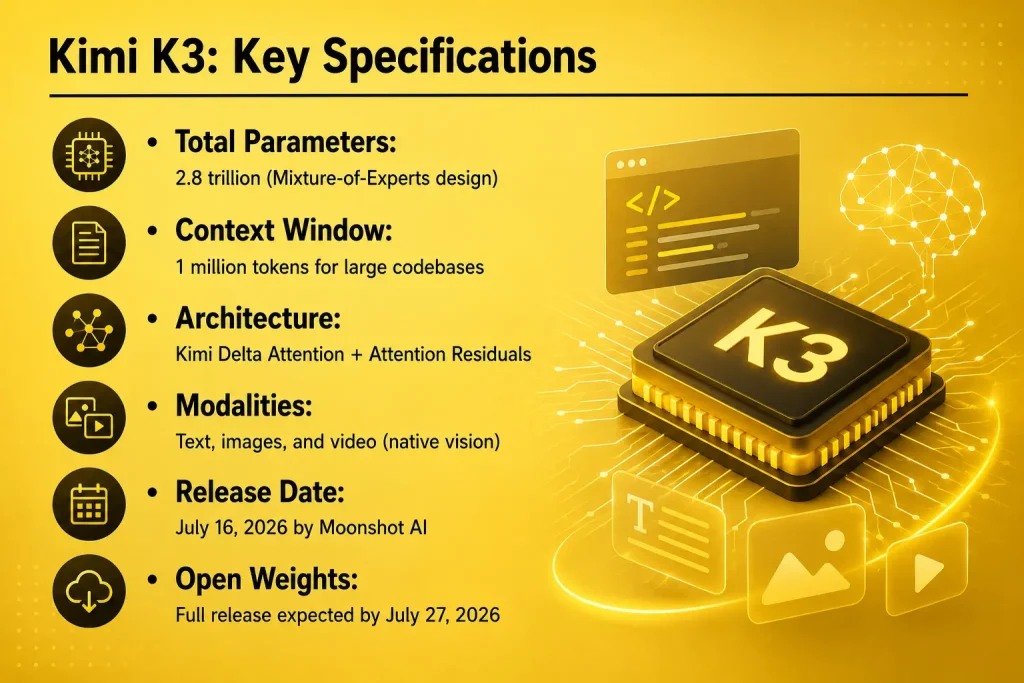
2.8T Parameters, 1M-Token Context Window
The Mixture of Experts (MoE) design of K3 has a total of 2.8 trillion parameters (with 896 experts), while 16 of them are active during a single inference. This makes the model efficient even if it’s huge. It also features:
- A 1-million-token context window, letting it read and remember huge codebases or documents in one go
- Kimi Delta Attention (KDA) and Attention Residuals, two architecture updates that improve how information moves through the model
- Native multimodal support, meaning it can process text, images, and video without needing separate tools
But the actual number is 2.8 trillion, and the world’s first open “3T-class” model is called Moonshot. All full open weight files will be due 27 July 2026.
Kimi K3 Coding Capabilities Explained
K3, as a whole, was designed to be a coding platform. However, it’s not only about type in snippets of code quickly. It’s the human engineer’s approach to an entire coding project, one step at a time, over an extended period of time.
This part will examine how K3 deals with long tasks and large, complex code bases.
Long-Horizon & Sustained Engineering
Most AI coding models fail when they have to complete too many steps or too long of a task. Kimi K3 is designed to prevent this. It can work on a project for long periods time without getting lost in its own work or requiring frequent human assistance.
This is very important for actual software projects. A single feature build could consist of coding, testing, bug fixing and more such activities a number of times. K3 wants to do that whole loop without a lot of supervision.
Large Codebases & Terminal Tools
K3 fully comprehends how all files and functions relate to each other in a project. It remembers a lot of code; it has one million tokens in its context window, as opposed to forgetting previous files.
It can also work directly with the tools of the terminal. This means it will be able to execute commands, look at the results and change its course of action accordingly instead of just randomizing.
How Kimi K3 Uses Visual Feedback
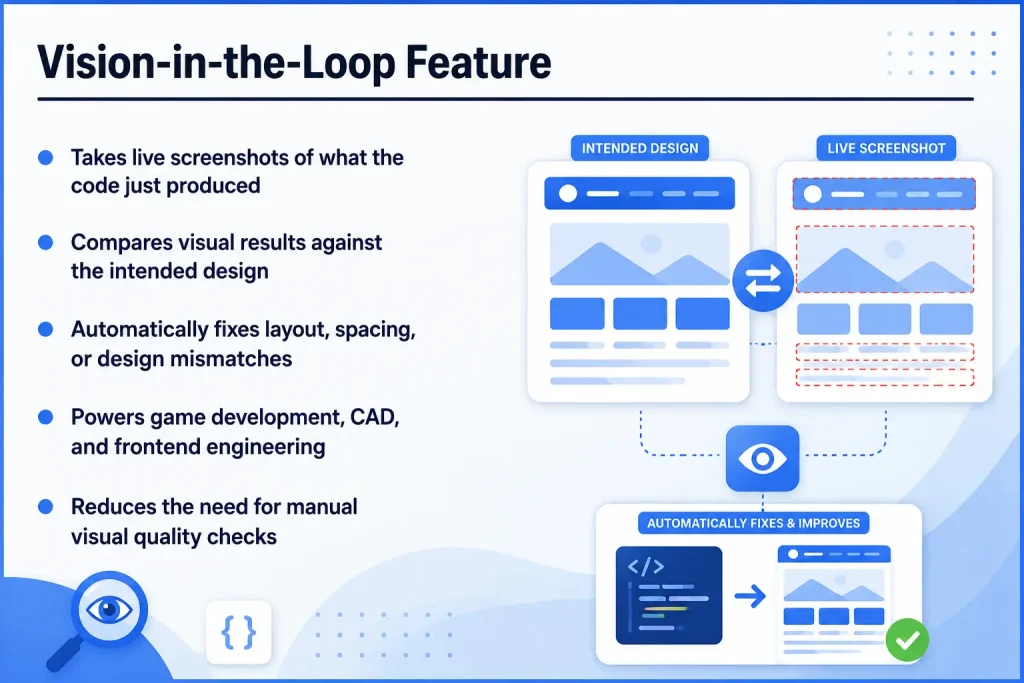
One of the more unique Kimi K3 abilities is what Moonshot is referring to as “vision in the loop. K3 doesn’t just read and write code, it can also take a look at the visual output of code and use that image to enhance its own code.
This combines coding with vision in a manner that’s more like working like a real developer.
Combining Code with Live Screenshots
K3 can take a screen shot of what it just built and view it and compare it to what it should build. When something is amiss, such as a button that is out of place, or a broken layout, it can go back and make the changes to the code itself.
This cycle of writing code and checking a screen and making further adjustments, happens automatically. It saves a man from manually looking at each and every fine detail.
Applications in Gaming, CAD, & Frontend
This vision-driven approach isn’t just for simple websites. Moonshot has demonstrated its ability to create playable 3D games and engaging interactive experiences directly from images, concepts, or even videos in K3. It also works for CAD-related design, where the accuracy of the drawings can be decisive.
For frontend engineering in particular, this feedback loop can be useful in identifying layout problems or design inconsistencies that a text-only system may fail to detect altogether.
Frontend Performance & Benchmarks
The most prominent feature of Kimi K3 is its ability to code the frontend. It was already at the top of a prominent coding leaderboard within hours of its release — a feat that no open-weight (Chinese) model had achieved at this scale before.
Let’s check out where it ranks amongst the best as compared to other top of the line models.
Arena Frontend Leaderboard
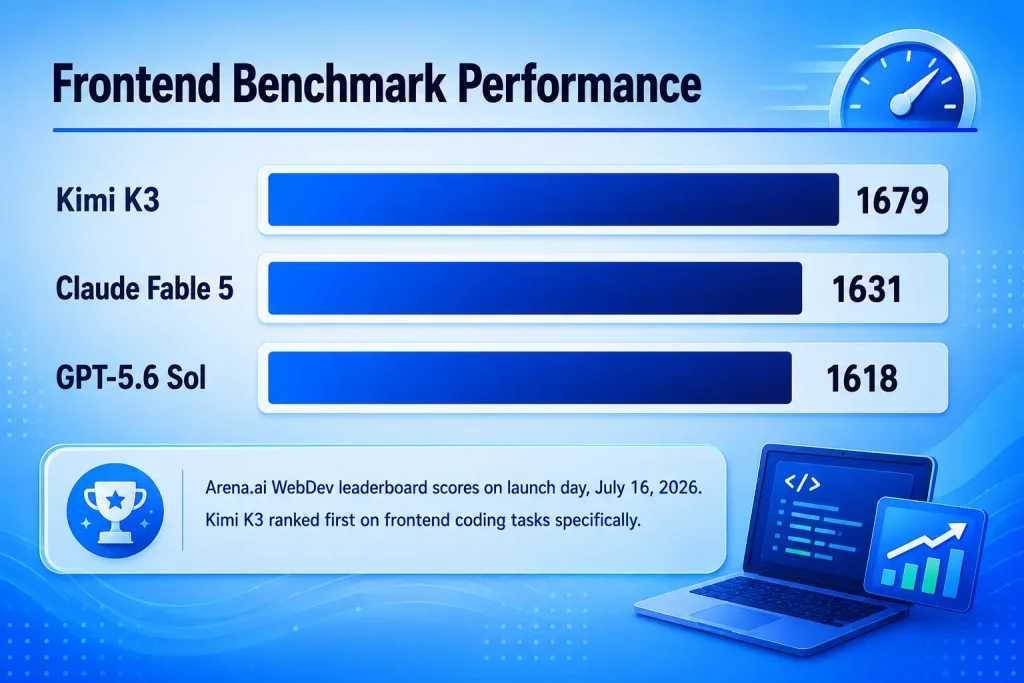
Kimi K3 launched on Arena.ai WebDev Leaderboard with a score of 1,679 on the day of launch 16th July 2026. This was better than Claude Fable 5 (1,631) and GPT-5.6 Sol (1,618). That’s a pretty good debut for an open weight model, and one of the largest closed models available today.
This is only for front end coding jobs, though. As far as more general and higher level comparisons are concerned, K3 is actually third overall behind the same two models it trounced on the front end board. The front-end victory is genuine and it’s a thing to keep track of, however here and there does not indicate that K3 is the greatest model for any one of the many kinds of jobs.
It’s also worth noting that this is a very fresh result. Developers have only had a few days to test K3 in real production workflows, so the full picture will likely become clearer over the coming weeks as more people put it through its paces.
How Kimi K3 Compares to Rivals
When considering more specific technical indicators, the picture is more complicated. In the tasks where Moonshot is behind GPT-5.6, it is on OmniDocBench, GPQA Diamond, MMMU-Pro, and Terminal-Bench 2.1, with K3 trailing on DeepSWE. Simply put, K3 does not sweep any board but only those that it was made to sweep the most.
Independent testing bears the same message. Kimi K3 has a score of 57 on the Artificial Analysis Intelligence Index, well above the average model in its class (with a median score of around 31). As a result, it produces output at roughly 62 tokens per second, slightly less than the typical model of this price level, which averages at 73.7 tokens per second. This means that it’s a good deal in terms of price, but not always the quickest solution at present.
Strengths and Limitations
All models have their weaknesses, and K3 is no different. Before blindly depending on it, it is crucial to know what it does well and what it doesn’t.
Where Kimi K3 Excels
K3’s biggest strength is clearly frontend and web development coding, backed by its leaderboard win. It’s also excellent at:
- Long, multi-step coding tasks that require little supervision
- Reading and working with extremely large codebases thanks to its 1M-token window
- Visual feedback loops for frontend, game, and CAD-style projects
- Being one of the largest and most capable open-weight models released so far
Known Weaknesses
K3 shows significant weaknesses in some technical aspects. Kimi K3 performs a bit badly on advanced mathematics (about 39 percent on the FrontierMath Tier 4) compared to some of the other models from OpenAI and Anthropic. It also doesn’t beat GPT-5.6 Sol on certain coding-related tests, such as Terminal-Bench or DeepSWE, which means it’s by no means the optimal choice for every engineering-related task, particularly those involving complex reasoning or fine logic.
Watch out for verbosity, too. K3’s independent evaluation revealed it generated approximately 130 million evaluation output tokens in comparison to a comparable model with a median of 63 million tokens. That’s because its lower price per token might be offset by the amount of text it actually produces, meaning that its actual costs can be higher than what it appears on the sticker.
Pricing and Availability
Pricing plays a big role in whether a model like this fits into a real workflow, especially for teams running lots of coding tasks daily.
API Access and Token Pricing
The official Kimi K3 API pricing is $0.30 per cache-hit input token, $3 per uncached input token, and $15 per output token. This places it in the price range of Anthropic’s Sonnet range of models, which is still a step up from Moonshot’s previous K2 models, which are on the lower price end.
The model can currently be accessed via the Kimi app, Kimi Work, Kimi Code, and the official Kimi API with the model Id of kimi-k3.
Open-Weight Release Timeline
The K3 (live and usable now via official channels), but the complete files for the open-weight are not currently released. Moonshot has stated that the weights will be available by July 27, 2026, allowing developers to upload their own copies to the platform or deploy it via other open-model vendors, if they have the hardware necessary to run such a large model.
Is Kimi K3 Right for Coding?
Strong results at the frontend, and some clear gaps elsewhere, K3 is best suited for particular types of projects, rather than as a substitute for all projects that you are using today.
Best Use Cases
Kimi K3 is a strong fit if you’re working on:
- Frontend-heavy projects like websites, dashboards, or UI-focused apps
- Long-running coding agents that need to work independently for hours
- Projects involving very large codebases that need to be read in full
- Work that benefits from combining visual feedback with code, like game development or CAD
Who Should Consider Alternatives
If you are already using an advanced math model or even specialized terminal-based debugging or even jobs that GPT-5.6 Sol is doing better, then you may want to use your current model for these particular uses. Even when moving over completely, K3’s verbosity will be a concern for teams with a high cost for output tokens.
Conclusion
The Kimi K3 is truly a milestone in the development of open-weight AI systems, particularly in coding. It is most clearly distinguished in frontend development by its Kimi K3 Coding Capabilities, which are among the best on the major benchmarks and even outperform the best closed models. It also introduces some truly helpful capabilities such as vision-based feedback loops, a massive context window, and long-horizon task handling. However, it is not the best for higher-level mathematics or all of the coding specialties. If front-end development is your primary concern, having a large codebase or using long-running coding agents, K3 is certainly something you should try out today..
FAQs
1. What is Kimi K3 used for?
Kimi K3 is mainly used for coding, especially long, multi-step engineering tasks, frontend development, and projects that combine code with visual feedback like screenshots.
2. Is Kimi K3 free to use?
No, Kimi K3 is not free. It’s priced at $3 per million input tokens and $15 per million output tokens, with a lower $0.30 rate for cached inputs.
3. When was Kimi K3 released?
Kimi K3 was released on July 16, 2026, by Moonshot AI, with full open-weight files expected by July 27, 2026.
4. Is Kimi K3 better than GPT-5.6 Sol or Claude?
It depends on the task. Kimi K3 leads on frontend coding benchmarks but trails GPT-5.6 Sol and Claude Fable 5 on several other technical and math-related benchmarks.
5. How big is Kimi K3?
Kimi K3 has 2.8 trillion total parameters, making it the largest open-weight model released to date, though it only activates a small portion of those parameters at a time.